Today's
EarthStation1.com 15% Off Commemorative Memorial Title: TV
Commercials: The Classics Vol. 9 DVD, MP4 Download, USB Flash
Drive
Today, March 9, 2026
March 9: National Meatball Day: -- It is not clear how this day got started, but who can resist the idea of celebrating National Meatball Day? There are many different ways to celebrate meatballs! There are early recipes for meatballs are found in ancient Chinese, Arabic and Roman texts, and virtually every culture has their own version! We can't put a number on the variety of meatballs in the world. Nor can we limit how many you put on your plate. One giant meatball will more than satisfy but a bowlful of smaller ones is easier to share. Beef, pork, and veal are most popular, but they can be made with chicken, fish or even vegan. Their variety is unquestionably a selling point. Not only do meatballs allow for variety, but they're flexible too! Meatballs move from appetizer to side dish to the main dish quite easily. Meatballs can be made the night before and put in the crockpot, or days before, and kept in the freezer. Early recipes for meatballs are found in ancient Chinese, Arabic and Roman texts, and every culture seems to have their own version! Beef, pork, and veal are most popular, but they can be made with chicken, fish or even vegan. On Sale @ 15% Off Discount Till Midnight PT! https://store.earthstation1.com/tv-commercials-the-classics-vol-9-dv9.html
Today's
EarthStation1.com 15% Off Commemorative Memorial Title: TV Toy
Commercials: The Classics 1950s-60s DVD, Download, USB Drive
Today, March 9, 2026
March 9, 1959: National Barbie Day: -- The Barbie doll makes its debut at the American International Toy Fair in New York. Barbie is a fashion doll manufactured by the American toy company Mattel, Inc. and created by American businesswoman Ruth Handler, who used a German doll called Bild Lilli as her inspiration. The Bild Lilli doll was a German fashion doll launched on August 12, 1955 and produced until 1964. Its design was based on the comic-strip character Lilli, created by Reinhard Beuthien for the German tabloid newspaper Bild. The doll was made of polystyrene, came in two sizes, and had an available wardrobe of 1950s fashion. The Lilli doll was the inspiration for Mattel co-founder Ruth Handler's creation of the Barbie doll. Production of the Bild Lilli doll ceased after Mattel bought the copyright. Ordered to draw a "filler" cartoon for the June 24, 1952, inaugural issue of Bild, Reinhard Beuthien drew an unruly baby; his editor disliked it, so he adapted the drawing into a sexy pony-tailed blonde sitting in a fortune-teller's tent. She was asking, "Can't you give me the name and address of this tall, handsome, rich man?" The cartoon was an immediate success and became a daily feature. Lilli was post-war, sassy and ambitious, "a golddigger, exhibitionist, and floozy". The cartoon always consisted of a picture of Lilli talking, while dressed or undressed in a manner that showed her figure, usually to girlfriends, boyfriends, or her boss. To a policeman who told her that two-piece swimsuits are banned in the street: "Oh, and in your opinion, what part should I take off?" The last Lilli cartoon appeared on January 5, 1961. On Sale @ 15% Off Discount Till Midnight PT! https://store.earthstation1.com/tv-toy-commercials-the-classics-dvd.html
Today's
EarthStation1.com 15% Off Commemorative Memorial Title: Archival
Cartoon Classics #2 Mutt And Jeff History And More! MP4 DVD
Today, March 9, 2026
March 9: Panic Day: -- The one day of the year that it might just be okay to give into that emotion that we all try to keep in check-panic! It is okay to feel overwhelmed or upset. Giving into that feeling every once in a while does not necessarily make a person weak or inept. So go ahead and mark your calendar, and hang on tight until you get to Panic Day! Once the day starts you can take the time to just let it all out, whether screaming into a pillow at home or climbing a mountain alone just to have a good yell after arriving at the top! Or it might be a day to recognize and apply some ways to avoid panic in the first place. When it comes to various holidays, many people may think of the ones that were created simply to celebrate the fun moments of life, which everyone loves. However, Panic Day was created as a day to recognize how stressful life can sometimes be, and then see what can be done to minimize the effects. Everyone knows that stress is detrimental to the health and can even be dangerous! Stress can bring on illnesses such as heart disease, high blood pressure, diabetes and obesity. Some people respond to stress by having feelings of panic which can be debilitating. Panic can make a person feel that their fear cannot be overcome. While this may not seem rational, the panic takes over and makes it difficult for the one stricken to be able to make rational choices. For those who feel that their fears and stress are overwhelming, Panic Day is the perfect day to make a step forward and reach out to a mental health professional. On Sale @ 15% Off Discount Till Midnight PT! https://store.earthstation1.com/archival-cartoon-classics-2-mutt-and-jeff-history-and-more-mp4-d24.html
Today's
EarthStation1.com 15% Off Commemorative Memorial Title: Columbus &
The Age Of Discovery TV Series + Bonus MP4 Download DVD Set
Today, March 9, 2026
March 9: Amerigo Vespucci Day: -- March 9, 1451: #BOTD: #HBD! Amerigo Vespucci, Italian merchant, explorer, and navigator from the Republic of Florence, from whose name the term "America" is derived (d. February 22, 1512) is #born in Florence, Italy. Between 1497 and 1504, Vespucci participated in at least two voyages of the Age of Discovery, first on behalf of Spain (1499-1500) and then for Portugal (1501-1502). In 1503 and 1505, two booklets were published under his name, containing colourful descriptions of these explorations and other alleged voyages. Both publications were extremely popular and widely read across much of Europe. Although historians still dispute the authorship and veracity of these accounts, at the time they were instrumental in raising awareness of the new discoveries and enhancing the reputation of Vespucci as an explorer and navigator. He first demonstrated in about 1502 that Brazil and the West Indies did not represent Asia's eastern outskirts as initially conjectured from Columbus' voyages, but instead constituted an entirely separate landmass hitherto unknown to people of the Old World. Vespucci claimed to have understood, back in 1501 during his Portuguese expedition when he explored South America and the Amazon River, that Brazil was part of a continent new to Europeans, which he called the "New World". The claim inspired cartographer Martin Waldseemuller to recognize Vespucci's accomplishments in 1507 by applying the Latinized form "America" for the first time to a map showing the New World. Other cartographers followed suit, and by 1532 the name America was permanently affixed to the newly discovered continents. It is unknown whether Vespucci was ever aware of these honours. In 1505, he was made a citizen of Castile by royal decree and in 1508, he was appointed to the newly created position of piloto mayor (master navigator) for Spain's Casa de Contratacion (House of Trade) in Seville, Crown Of Castile (modern Spain), a post he held until he died there of malaria, aged 60. He is buried at Ognissanti Church, Florence, Italy, the city of his birth. On Sale @ 15% Off Discount Till Midnight PT! https://store.earthstation1.com/columbus-and-the-age-of-discovery-epic-7-hourlong-episode-tv-serie7.html
Today's
EarthStation1.com 15% Off Commemorative Memorial Title: Lewis And
Clark & The Corps Of Discovery Expedition DVD MP4 USB Stick
Today, March 9, 2026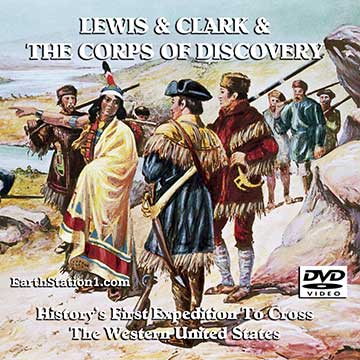
March 9-10: Three Flags Day: -- March 9-10, 1804: The United States: The History Of The United States: The Territorial Expansion Of The United States (The Territorial Evolution Of The United States): The Louisiana Purchase: -- March 9: -- New Spain (Louisiana) is turned over by Spain to France on the first day of the two-day ceremony known as Three Flags Day; the following day, March 10, the formal ceremony to transfer ownership of the Louisiana Territory from France to the United States concludes in St. Louis, Missouri, in order to finalize the 1803 Louisiana Purchase. The ceremony in St. Louis cleared the way for Lewis And Clark to begin their exploration. On Sale @ 15% Off Discount Till Midnight PT! https://store.earthstation1.com/lewis-amp-clark-amp-the-corps-of-discovery-dvd-mp4-usb-driv4.html
Today's
EarthStation1.com 15% Off Commemorative Memorial Title: Ironclads:
Monitor Vs. Merrimac DVD, MP4 Video Dowload, USB Drive
Today, March 9, 2026
March 9: Bang Clang Day: -- March 9, 1862: The American Civil War (The Civil War, The War Between The States): Naval Warfare Of The American Civil War (Naval Battles Of The American Civil War): The Battle Of Hampton Roads (The Battle Of The Monitor And The Merrimack, The Battle Of The Ironclads): -- The USS Monitor and CSS Virginia fight to a draw in the first battle between two ironclad warships. The Naval Battle of Hampton Roads, often referred to as either the Battle of the Monitor and Merrimack (or Virginia) or the Battle of Ironclads, is the most noted and arguably most important naval battle of the American Civil War from the standpoint of the development of navies. It was fought over two days, March 8-9, 1862, in Hampton Roads, a roadstead in Virginia where the Elizabeth and Nansemond rivers meet the James River just before it enters Chesapeake Bay adjacent to the city of Norfolk. The battle was a part of the effort of the Confederacy to break the Union blockade, which had cut off Virginia's largest cities and major industrial centers, Norfolk and Richmond, from international trade. The major significance of the battle is that it was the first meeting in combat of ironclad warships, USS Monitor and CSS Virginia. The Confederate fleet consisted of the ironclad ram Virginia (built from the remnants of the under-construction steam frigate USS Merrimack, newest warship for the United States Navy / Union Navy) and several supporting vessels. On the first day of battle, they were opposed by several conventional, wooden-hulled ships of the Union Navy. On that day, Virginia was able to destroy two ships of the federal flotilla, USS Congress and USS Cumberland, and was about to attack a third, USS Minnesota, which had run aground. However, the action was halted by darkness and falling tide, so Virginia retired to take care of her few wounded-which included her captain, Flag Officer Franklin Buchanan-and repair her minimal battle damage. Determined to complete the destruction of Minnesota, Catesby ap Roger Jones, acting as captain in Buchanan's absence, returned the ship to the fray the next morning, March 9. During the night, however, the ironclad Monitor had arrived and had taken a position to defend Minnesota. When Virginia approached, Monitor intercepted her. The two ironclads fought for about three hours, with neither being able to inflict significant damage on the other. The duel ended indecisively, Virginia returning to her home at the Gosport Navy Yard for repairs and strengthening, and Monitor to her station defending Minnesota. The ships did not fight again, and the blockade remained in place. The battle received worldwide attention, and it had immediate effects on navies around the world. The preeminent naval powers, Great Britain and France, halted further construction of wooden-hulled ships, and others followed suit. Although Britain and France had been engaged in an iron-clad arms race since the 1830s, the Battle of Hampton Roads signaled a new age of naval warfare had arrived for the whole world. A new type of warship, monitor, was produced based on the principle of the original. The use of a small number of very heavy guns, mounted so that they could fire in all directions, was first demonstrated by Monitor but soon became standard in warships of all types. Shipbuilders also incorporated rams into the designs of warship hulls for the rest of the century. On Sale @ 15% Off Discount Till Midnight PT! https://store.earthstation1.com/ironclads-monitor-vs-merrimac-dvd-us-civil-war-documentary.html
Today's
EarthStation1.com 15% Off Commemorative Memorial Title: The
History Of Jazz A Video Retrospective MP4 Video Download Or DVD
Today, March 9, 2026
March 9: Ornette Coleman Day: -- March 9, 1930: #BOTD: #HBD! Ornette Coleman, African American jazz saxophonist, violinist, trumpeter, and composer, best known as a principal founder of the free jazz genre, a term derived from his 1960 album Free Jazz: "A Collective Improvisation" (d. June 11, 2015) is #born Randolph Denard Ornette Coleman in Fort Worth, Texas. His pioneering works often abandoned the harmony-based composition, tonality, chord changes, and fixed rhythm found in earlier jazz idioms. Instead, Coleman emphasized an experimental approach to improvisation, rooted in ensemble playing and blues phrasing. Born and raised in Fort Worth, Texas, Coleman taught himself to play the saxophone when he was a teenager. He began his musical career playing in local R & B and bebop groups, and eventually formed his own group in Los Angeles featuring members such as Ed Blackwell, Don Cherry, Charlie Haden, and Billy Higgins. In November 1959, his quartet began a controversial residency at the Five Spot jazz club in New York City and he released the influential album The Shape of Jazz to Come, his debut LP on Atlantic Records. Coleman's subsequent Atlantic releases in the early 1960s would profoundly influence the direction of jazz in that decade, and his compositions "Lonely Woman" and "Broadway Blues" became genre standards that are cited as important early works in free jazz. In the mid 1960s, Coleman left Atlantic for labels such as Blue Note and Columbia Records, and began performing with his young son Denardo Coleman on drums. He explored symphonic compositions with his 1972 album Skies of America, featuring the London Symphony Orchestra. In the mid-1970s, he formed the group Prime Time and explored electric jazz-funk and his concept of harmolodic music. In 1995, Coleman and his son Denardo founded the Harmolodic record label. His 2006 album Sound Grammar received the Pulitzer Prize for Music, making Coleman the second jazz musician ever to receive the honor. Ornette Coleman died of cardiac arrest at the age of 85 in New York City. His funeral was a three-hour event with performances and speeches by several of his collaborators and contemporaries. On Sale @ 15% Off Discount Till Midnight PT! https://store.earthstation1.com/the-history-of-jazz-by-billy-taylor-parts-i-amp-ii-dvd.html
Today's
EarthStation1.com 15% Off Commemorative Memorial Title: Norman's
Corner (1987) Gilbert Gottfried TV Special DVD, Download, USB
Today, March 9, 2026
March 9: Joe Franklin Day: -- March 9, 1926: #BOTD: #HBD! Joe Franklin, American radio and television host personality, author and actor from New York City (d. January 24, 2015) is #born Joseph Fortgang in The Bronx, New York. His television series debuted in January 1951 on WJZ-TV (later WABC-TV), moving to WOR-TV (later WWOR-TV) in 1962, remaining there until 1993, one of the longest running uninterrupted careers in broadcasting history. Franklin was the elder of two children, to Austrian Jewish parents, Anna (Heller) and Martin Fortgang. He acknowledged in his memoirs, Up Late With Joe Franklin, (which was written with R. J. Marx), that his press materials had long said, purposely, that he had been born in 1928, but he planned to come clean about his real birth date. As a teenager, Franklin "followed around" Al Jolson and Eddie Cantor, the latter of whom eventually began buying jokes from the young Franklin and whose Carnegie Hall show he later produced. At age 18, Franklin was drafted into the United States Army, serving in World War II. At 14, Franklin began writing skits for The Kate Smith Hour; and at 16, Franklin officially began his entertainment career as a record picker on radio sensation Martin Block's Make Believe Ballroom where he became known as "The Young Wreck with the Old Records". By the time he was 21, he embarked on a radio career. He was also considered to be an authority on popular culture of the first half of the 20th century, including silent films. He was called "The King of Nostalgia" and "The Wizard of Was" for focusing on old-time show-business personalities. Franklin was also a pioneer in promoting products such as Hoffman Beverages and Canada Dry ginger ale on the air. A & E's documentary It's Only Talk, The Real Story Of America's Talk Shows credits Franklin as the creator of the television talk show. Franklin was listed in the Guinness World Records as the longest running continuous on-air TV talk show host, more than a decade longer than Johnny Carson's run. In 1999, Franklin partnered with Producer Steve Garrin and Restaurant Mogul Dennis Riese to open Joe Franklin's Memory Lane Restaurant on West 45th Street in Broadway's theater district. After the restaurant closed in 2003 it reopened the following year as "Joe Franklin's Comedy Club" on West 50th Street. Many name comedians came to the club and performed on stage to break in their new material, and many aspiring comics got their first stage time there. It closed in 2005. After retiring from his television show, Franklin concentrated on his overnight radio show, playing old records on WOR-AM on Saturday evenings and mentoring thousands of aspiring entertainers who for decades sought an audience with him at his notoriously cluttered Times Square office. Franklin's celebrity interviews, known as "Nostalgia Moments", appeared daily on the Bloomberg Radio Network until mid-January 2015, shortly before his death. Franklin's guests included an eclectic mix of actual celebrities and low level performers, sometimes on the same panel. He claimed to have had Charlie Chaplin on his program, a dubious statement since Chaplin left the United States in 1952, shortly after Franklin's TV debut. Franklin took credit for discovering or giving early exposure to Al Pacino, Bette Midler, Barbra Streisand, Michael Jackson, Garth Brooks and Woody Allen. He interviewed Andy Warhol and Howard Stern, William F. Buckley and Abbie Hoffman, Jack LaLanne and Muhammad Ali, Fred Astaire and John Wayne. Other guest claims include Judy Garland, Marilyn Monroe (with whom Franklin co-authored "The Marilyn Monroe Story" in 1953), Jayne Mansfield, The Beastie Boys, Cary Grant, Sam Levene, Lena Horne, Tony Bennett, Salvador Dali, Rudy Vallee, Jimmy Durante, Madonna, John Lennon and Yoko Ono, Bing Crosby, Jerry Lewis, Roger Williams, The Belmonts, Elvis Presley, The Ramones, Lou Albano and five US presidents (including John F. Kennedy and Richard Nixon). As with the Chaplin claim, some of these appearances were unable to be independently confirmed based on a lack of evidence, since still pictures taken on the set do not exist for several of the people listed, and little video from before the 1970s survives. Bette Midler was the show's in-house singer for a time, and Barry Manilow her accompanist. Elizabeth Joyce was his in-house psychic/astrologer. Franklin never employed a co-host, but his producer, Richie Ornstein, was a standard feature on the Joe Franklin Show who interacted with guests and discussed trivia. Woody Allen, Andy Kaufman, Liza Minnelli, Barbra Streisand, Julia Roberts, Bruce Springsteen, Robin Williams, John Belushi and Richard Pryor got their first television exposure on The Joe Franklin Show. Frank Sinatra reportedly appeared four times. Franklin frequently appeared at his restaurant, where he conducted live, in-person interviews with entertainers such as Carol Channing, Anita O'Day and Billy Crystal, who impersonated Franklin on Saturday Night Live. Franklin appeared as himself in such New York-based films as Ghostbusters, Broadway Danny Rose, and 29th Street. Franklin appeared on the first episode of This American Life giving host Ira Glass advice on how to have a successful show. He was also a guest on an early episode of Space Ghost Coast to Coast. He also made appearances in various works by New York low-budget film company Troma Entertainment, making a cameo as himself in their 1999 meta-fictional slasher film Terror Firmer, as well as the 1993 infomercial The Troma System as the result of the commercial's host transforming into "the ultimate talk show host". Franklin appeared as himself in comedian Tracey Ullman's 1993 HBO comedy special Tracey Ullman Takes on New York, interviewing character Linda Granger on his talk show. Franklin's show was first parodied by Billy Crystal during the 1984-1985 season of Saturday Night Live. On the locally produced program The Uncle Floyd Show, host Floyd Vivino parodied Franklin as "Joe Frankfurter". In 1997, Franklin was profiled in the documentary film 50,000,000 Joe Franklin Fans Can't Be Wrong (1997), directed by Joshua Brown. Also in 1997, Franklin was satirized by Drew Friedman in * Any Similarity to Persons Living or Dead is Purely Coincidental (with Josh Alan Friedman) (Fantagraphics Books, 1997). In the 2005 film The Aristocrats, comedian Sarah Silverman tells a fictional story about Franklin raping her as a young performer. Franklin, who also appears in the film, said he considered filing a lawsuit, but it appears that none was ever filed. In 2014, Franklin starred in Owen Kline and Andrew Lampert's comedic short film Jazzy for Joe, which featured Franklin raising an abandoned baby discovered on his doorstep. The film was programmed by Robert Downey Sr. and run as the finale of a 2014 retrospective of his own filmography at the late West Hollywood theater Cinefamily. "It's a 13-minute film that's just great and the right spirit of those years, way back, when we were all helping each other. This film is great." Franklin married Lois Meriden, a onetime performer with Sally Rand's burlesque-style "fan dancers". They had a son, Bradley. Later, Franklin's longtime companion was Jodi Fritz. Joe Franklin died of prostate cancer at a Manhattan hospice aged 88. On Sale @ 15% Off Discount Till Midnight PT! https://store.earthstation1.com/norman39s-corner-1987-dvd-gilbert-gottlfried-comedy-s391987.html
Today's
EarthStation1.com 15% Off Commemorative Memorial Title: Desiree
(1954) Marlon Brandon As Napoleon DVD, Download, USB Drive
Today, March 9, 2026
March 9, 1796: The Age Of Enlightenment (The Enlightenment, The Age Of Reason): The Age Of Revolution: The Atlantic Revolutions: The French Revolution: The French Revolutionary And Napoleonic Wars (The Great French War) (The French Revolutionary Wars, The Napoleonic Wars): The Marriage Of Napoleon And Josephine Bonaparte: -- Napoleon Bonaparte marries his first wife, Josephine de Beauharnais, the future Empress Josephine (June 23, 1763 - May 29, 1814). She was born Marie-Josephe-Rose Tascher de la Pagerie in Les Trois-Ilets, Martinique, French Antilles. She was the first wife of Napoleon I, and thus the first Empress Of The French as Josephine. Her marriage to Napoleon I was her second; her first husband, Alexandre de Beauharnais, was guillotined during The Reign Of Terror, and she was imprisoned in the Carmes prison until five days after his execution. Her two children by Beauharnais became significant to royal lineage. Through her daughter, Hortense, she was the maternal grandmother of Napoleon III. Through her son, Eugene, she was the great-grandmother of later Swedish and Danish kings and queens. The reigning houses of Belgium, Norway and Luxembourg also descend from her. She did not bear Napoleon any children; as a result, he divorced her in 1810 to marry Marie Louise of Austria. Josephine was the recipient of numerous love letters written by Napoleon, many of which still exist. Her Chateau de Malmaison was noted for its magnificent rose garden, which she supervised closely, owing to her passionate interest in roses, collected from all over the world. Josephine died of pneumonia at age 50 in Rueil-Malmaison, soon after walking with Emperor Alexander I of Russia in the gardens of Malmaison, where she allegedly begged to join Napoleon in exile. She was buried in the nearby church of Saint Pierre-Saint Paul in Rueil. Her daughter Hortense is interred near her. Napoleon learned of her death via a French journal while in exile on Elba, and stayed locked in his room for two days, refusing to see anyone. He claimed to a friend, while in exile on Saint Helena, that "I truly loved my Josephine, but I did not respect her." Despite her numerous affairs, eventual marriage annulment, and his remarriage, the Emperor's last words on his death bed at St. Helena were: "France, the Army, the Head of the Army, Josephine."("France, l'armee, tete d'armee, Josephine"). On Sale @ 15% Off Discount Till Midnight PT! https://store.earthstation1.com/desiree-1954-dvd-marlon-brando-as-napoleon-jean-sim1954.html
Today's
EarthStation1.com 15% Off Commemorative Memorial Title: The
Gallant Breed: US Marine Chronicles + 4 Bonuses MP4 Download DVD
Today, March 9, 2026
March 9, 1847: The Mexican-American War (The Mexican War): The Siege Of Veracruz (The Battle Of Veracruz): -- The United States Marine Corp launches the first large-scale amphibious assault in U.S. history when it lands at the Mexican beachhead seaport of Veracruz and besieges if for 20 days until it surrendered and was occupatied by U.S. forces, who then marched inland to Mexico City. The commander of the operation, Major General Winfield Scott, agreed with Commodore David Conner's suggestion for a landing site at Collado Beach, 3 mi (4.8 km) south of Veracruz. The 1st Regular Division under General William J. Worth was chosen to make the landing first, followed by General Robert Patterson's volunteers and then General David E. Twiggs' regular division. Conner's Mosquito Fleet, a United States Navy squadron detachment of small gunboats, moved to within 90 yd (82 m) of the beach to supply covering fire if necessary. By 12:15 pm this force was off Collado Beach, followed by larger vessels over the next three hours and a signal for landing the surfboats at 5:30 pm. Just before the main force touched the beach, General Worth's gig (a boat used on naval ships as the captain's taxi) dashed ahead, and he and his staff jumped ashore. Worth's whole division landed without firing or receiving a single shot. By 11 pm, Scott's entire army had been brought ashore without a single man lost, and the first large scale amphibious landing conducted by the U.S. military was a success. The Battle of Veracruz was a 20-day siege of the key Mexican beachhead seaport of Veracruz, during the Mexican-American War. Lasting from March 9-29, 1847, it began with the first large-scale amphibious assault conducted by United States military forces, and ended with the surrender and occupation of the city. U.S. forces then marched inland to Mexico City. On Sale @ 15% Off Discount Till Midnight PT! https://store.earthstation1.com/the-gallant-breed-dvd-set-3-part-us-marine-history-2-dis32.html
Today's
EarthStation1.com 15% Off Commemorative Memorial Title: Ulysses S.
Grant & The Battle Of The Wilderness DVD MP4 USB Drive
Today, March 9, 2026
March 9, 1864: The American Civil War (The Civil War, The War Between The States): The Union (The North, The United States Of America, USA, U.S.A.. The United States, US, U.S., America): -- Ulysses S. Grant is commissioned as a Lieutenant General and became the Sixth Commanding General of the United States Army, putting him in command of all the Union armies. Ulysses S. Grant (1822-1885), American U.S. Civil War General, 18th President of the United States (d. 1885) was born in Point Pleasant, Ohio. Ulysses Simpson Grant, born Hiram Ulysses Grant, served as Commanding General of the Army and then the President of the United States, the highest positions in the military and the government of the United States. A prominent United States Army general during the American Civil War, Grant led the Union Army to victory over the Confederacy with the supervision of Abraham Lincoln. As the 18th President of the United States (1869-77) Grant led the Republicans in their efforts to remove the vestiges of Confederate nationalism and slavery during Reconstruction. Grant was born and raised in Ohio by Methodist parents whose lineage in the new world went back several generations. As a youth he often worked in his father's tannery and showed an early talent for riding, taming and managing horses. After graduating from West Point in 1843 Grant served with distinction in the Mexican-American War. Upon his return he married Julia Dent, and together they had four children. Grant retired from the army in 1854 and struggled financially in civilian life. When the Civil War began in 1861 he rejoined the army and quickly rose through the ranks. During the war, he earned the nickname "Unconditional Surrender" Grant . As a general he took control of Kentucky, most of Tennessee, won major battles at Shiloh and seized Vicksburg, gaining control of the Mississippi River and dividing the Confederacy. These victories, combined with those in the Chattanooga Campaign, persuaded Abraham Lincoln that Grant was the general best suited to lead the combined Union armies. Grant was promoted to Lieutenant General, a rank previously reserved for George Washington, in March 1864. He confronted Robert E. Lee, trapping his army in their defense of Richmond, while coordinating a series of campaigns in other theaters. In April 1865 Lee surrendered to Grant at Appomattox, effectively ending the war. Historians have hailed Grant's military genius, and his strategies are featured in military history textbooks. After Lincoln's assassination, Grant became increasingly disillusioned by President Andrew Johnson's approach to Reconstruction, and drifted toward the "Radical" Republicans. Elected president in 1868, the youngest man in the office to that date, Grant stabilized the post-war national economy, created the Department of Justice, used the military to enforce laws in the former Confederacy and prosecuted the Ku Klux Klan. Grant strengthened the Republican Party in the South and signed three civil rights acts into law. He appointed African Americans and Jewish-Americans to prominent federal offices. In 1871 he created the first Civil Service Commission. The Democrats and Liberal Republicans united behind Grant's opponent in the presidential election of 1872, but Grant was re-elected by a large margin. Generally regarded as personally honest, he nonetheless faced accusations of corruption within his administration. Grant's Peace Policy with Native Americans was a bold departure for its time. In foreign policy, Grant sought to increase trade and influence while remaining at peace with the world. With Secretary Of State Hamilton Fish, he successfully resolved the Alabama claims with Great Britain (a series of demands for damages sought by the government of the United States from the United Kingdom in 1869 for the attacks upon Union merchant ships by Confederate Navy commerce raiders built in British shipyards during the American Civil War, focused chiefly on damages by the most famous of these raiders, the CSS Alabama, which took more than sixty prizes before she was sunk off the French coast in 1864). Grant and Fish negotiated a peaceful resolution with Spain over the Virginius Affair. Congress rejected Grant's initiative to annex the Dominican Republic, creating a rift among Republicans. Grant's immediate response to the Panic of 1873 failed to halt a severe industrial depression that produced high unemployment, deflation, and bankruptcies. When he left office in 1877, Grant embarked on a two-and-a-half-year world tour that captured favorable global attention for him and the United States. In 1880, Grant was unsuccessful in obtaining the Republican presidential nomination for a third term. Facing severe investment reversals and dying of throat cancer, he wrote his memoirs, which proved to be a major critical and financial success. His death in 1885 prompted an outpouring in support of national unity. Historical assessments of Grant's legacy have varied considerably over the years. Although Grant's presidency has popularly been criticized for its Gilded Age scandals, modern scholarship regards him as an embattled president who performed a difficult job during Reconstruction. Although early rankings of Presidents rated his administration among the worst, modern appreciation for Grant's support of civil rights and diverse federal appointments has greatly improved his historical reputation. On Sale @ 15% Off Discount Till Midnight PT! https://store.earthstation1.com/ulysses-s-grant-amp-the-battle-of-the-wilderness-dvd-mp4-usb-driv4.html
Today's
EarthStation1.com 15% Off Commemorative Memorial Title: Monster: A
Portrait Of Stalin In Blood TV Series DVD, Download, USB
Today, March 9, 2026
March 9, 1890: #BOTD: Vyacheslav Molotov, Soviet Russian politician and diplomat, Soviet Minister of Foreign Affairs (d. November 8, 1986) is #born Vyacheslav Mikhailovich Skryabin in the village of Kukarka, Yaransk Uyezd, Vyatka Governorate (now Sovetsk, Kirov Oblast), the son of a merchant. Contrary to a commonly-repeated error, he was not related to the composer Alexander Scriabin. Throughout his teenager years, he was described as "shy" and "quiet" and always assisted his father with his business. Vyacheslav Mikhailovich Molotov was an Old Bolshevik, and a leading figure in the Soviet government from the 1920s, when he rose to power as a protege of Joseph Stalin. Molotov served as Chairman of the Council of People's Commissars (Premier) from 1930 to 1941, and as Minister of Foreign Affairs from 1939 to 1949 and from 1953 to 1956. He served as First Deputy Premier from 1942 to 1957, when he was dismissed from the Presidium of the Central Committee by Nikita Khrushchev. The Molotov cocktail is a term coined by the Finns during the Winter War of 1939-1940, as a generic name used for a variety of improvised incendiary weapons. Molotov retired in 1961 after several years of obscurity. Molotov was the principal Soviet signatory of the Nazi-Soviet non-aggression pact of 1939 (also known as the Molotov-Ribbentrop Pact), whose most important provisions were added in the form of a secret protocol that stipulated an Invasion Of Poland and partition of its territory between Nazi Germany and the Soviet Union. He was aware of the Katyn massacre committed by the Soviet authorities during this period. After World War II (Great Patriotic War), Molotov was involved in negotiations with the Western allies, in which he became noted for his diplomatic skills. He retained his place as a leading Soviet diplomat and politician until March 1949, when he fell out of Stalin's favour and lost the foreign affairs ministry leadership to Andrei Vyshinsky. Molotov's relationship with Stalin deteriorated further, with Stalin criticising Molotov in a speech to the 19th Party Congress. However, after Stalin's death in 1953, Molotov was staunchly opposed to Khrushchev's de-Stalinisation policy. Molotov defended Stalin's policies and legacy until his death in 1986, and harshly criticised Stalin's successors, especially Khrushchev. Vyacheslav Molotov died at Kuntsevo Hospital in Moscow, Russian SFSR, Soviet Union during the rule of Mikhail Gorbachev, aged 96; Molotov had suffered and survived seven previous heart attacks. At the time of his death, he was the last surviving major participant in the events of 1917. He is buried in the Novodevichy Cemetery in Moscow. On Sale @ 15% Off Discount Till Midnight PT! https://store.earthstation1.com/monster-a-portrait-of-stalin-in-blood-dvd-tv-series-2-disc2.html
Today's
EarthStation1.com 15% Off Commemorative Memorial Title: Red
Express: TV Series On Trans-Siberian Railway Cities DVD, MP4, USB
Today, March 9, 2026
March 9, 1891: The History Of Rail Transport (The History Of Railways): The History Of Rail Transportation In Russia: The Trans-Siberian Railway (The Great Siberian Route, Transsib): -- The construction of the longest railway line in the world begins, The Trans-Siberian Railway, connecting European Russia to the Russian Far East, had its grand opening on June 21, 1904. Spanning a length of over 9,289 kilometers (5,772 miles), it runs from the city of Moscow in the west to the city of Vladivostok in the east. During the period of the Russian Empire, government ministers-personally appointed by Alexander III and his son Nicholas II-supervised the building of the railway network between 1891 and 1916. Even before its completion, the line attracted travelers who documented their experiences. Since 1916, the Trans-Siberian Railway has directly connected Moscow with Vladivostok. As of 2021, expansion projects remain underway, with connections being built to Russia's neighbors (namely Mongolia, China, and North Korea). Additionally, there have been proposals and talks to expand the network to Tokyo, Japan, with new bridges that would connect the mainland railway through the Russian island of Sakhalin and the Japanese island of Hokkaido. On Sale @ 15% Off Discount Till Midnight PT! https://store.earthstation1.com/red-express-tv-series-historic-transsiberian-railway-trip-2-dvd2.html
Today's
EarthStation1.com 15% Off Commemorative Memorial Title: Antony &
Cleopatra Samuel Barber's Opera Shakespeare's Words MP4 DVD
Today, March 9, 2026
March 9, 1910: #BOTD: #HBD! Samuel Barber, American pianist and composer of orchestral, opera, choral, and piano music (d. January 23, 1981) is #born Samuel Osmond Barber II in West Chester, Pennsylvania. One of the most celebrated composers of the 20th century, Barber's music usually eschewed the experimental trends of musical modernism in favor of traditional 19th-century harmonic language and formal structure embracing lyricism and emotional expression. However, he adopted elements of modernism after 1940 in some of his compositions, such as an increased use of dissonance and chromaticism in the Cello Concerto (1945) and Medea's Dance of Vengeance (1955); and the use of tonal ambiguity and a narrow use of serialism in his Piano Sonata (1949), Prayers of Kierkegaard (1954), and Nocturne (1959). Barber was adept at both instrumental and vocal music. His works became successful on the international stage and many of his compositions enjoyed rapid adoption into the classical performance canon. In particular, his Adagio for Strings (1936) has earned a permanent place in the orchestral concert repertory, as has that work's adaptation for chorus, Agnus Dei (1967). He received the Pulitzer Prize for Music twice: for his opera Vanessa (1956-57), and for the Concerto for Piano and Orchestra (1962). Also widely performed is his Knoxville: Summer of 1915 (1947), a setting for soprano and orchestra of a prose text by James Agee. At the time of Barber's death, nearly all of his compositions had been recorded. Many of his compositions were commissioned or first performed by such noted groups and artists as the Boston Symphony Orchestra, the Philadelphia Orchestra, the New York Philharmonic, the Metropolitan Opera, Vladimir Horowitz, Eleanor Steber, Raya Garbousova, John Browning, Leontyne Price, Pierre Bernac, Francis Poulenc, and Dietrich Fischer-Dieskau. While Barber composed a significant body of purely instrumental music, two-thirds of his compositional output was art songs for voice and piano, choral music, and songs for voice and orchestra. Some of his most frequently performed songs include both the solo voice and choral versions of Sure on this shining night (solo version from 1938 and choral version from 1961) with text by Agee; and the song cycle Hermit Songs (1953), with anonymous texts by Irish monks from the eighth through thirteenth centuries. This emphasis on sung material was rooted in his own brief career as a professional baritone in his 20s which inspired a lifelong love of vocal music. In 1935, Barber recorded his own setting of Arnold's "Dover Beach" for NBC, accompanying his own singing voice, and was also featured weekly on NBC Radio in 1935-1936 performing of German lieder and art songs. He also occasionally conducted performances and recordings of his works with symphony orchestras during the 1950s, and taught composition at the Curtis Institute from 1939-1942. Barber was in a relationship with the composer Gian Carlo Menotti for more than 40 years. They lived at Capricorn, a house just north of New York City, where they frequently hosted parties with academic and music luminaries. Menotti was Barber's librettist for two of his three operas. When the relationship ended in 1970, they remained close friends until Barber's death from cancer at his 907 Fifth Avenue apartment in Manhattan at the age of 70; Barber had been hospitalized on and off between 1978 and 1981 while undergoing treatment for the disease. His funeral was held at the First Presbyterian Church of West Chester three days later, and he was buried in the Oaklands Cemetery there. His final composition, Canzone for oboe and string orchestra (1981), was published after his death; initially intended to be a fully developed oboe concerto, Barber only completed the second movement of that work. On Sale @ 15% Off Discount Till Midnight PT! https://store.earthstation1.com/antony-amp-cleopatra-samuel-barber39s-opera-shakespeare39s-words3939.html
Today's
EarthStation1.com 15% Off Commemorative Memorial Title: The
Mexican Revolution 1910-1920 DVD, Video Download, USB Drive
Today, March 9, 2026
March 9, 1916: 20th Century Revolutions: The Mexican Revolution: The Mexican Border War: The Battle Of Columbus (The Burning Of Columbus, The Columbus Raid): -- Pancho Villa leads his nearly 500-man Division Of The North in a raid on the small United States border town of Columbus, New Mexico, located 3 miles north of the border. The raid escalated into a full-scale battle between Villistas and the United States Army. Villa himself led the assault, only to be driven back into Mexico by elements of the 13th Cavalry Regiment stationed at the town. The attack angered Americans, and on March 14, 1916, President Woodrow Wilson ordered ordered Brigadier General John J. Pershing to lead the "Punitive Expedition, US Army", or Punitive Expedition, in which the US Army invaded Mexico in an unsuccessful attempt to capture General Villa. The Punitive Expedition is now commonly known as The Pancho Villa Expedition and officially in the United States as the Mexican Expedition (March 14, 1916, - February 7, 1917), was an incident of The Mexican Border War (November 20, 1910 - June 16 ,1919), a series of military engagements which took place between the United States military and several Mexican factions in the Mexican-American border region of North America during the Mexican Revolution. The declared objective of the expedition by the administration of US President Woodrow Wilson was the capture of Villa; despite locating and defeating the main body of Villa's command who were responsible for the Columbus raid, US forces were unable to achieve Wilson's stated main objective of preventing Villa's escape. The active search for Villa ended after a month in the field when troops sent by Venustiano Carranza, the head of the Constitutionalist faction of the revolution and then head of the Mexican government, resisted the US incursion. The Constitutionalist forces used arms at the town of Parral to resist passage of a US Army column. The US mission was changed to prevent further attacks on it by Mexican troops and to plan for the possibility of war. When war was averted diplomatically, the expedition remained in Mexico until February 1917 to encourage Carranza's government to pursue Villa and prevent further raids across the border. On Sale @ 15% Off Discount Till Midnight PT! https://store.earthstation1.com/the-ragged-revolution-mexican-revolt-191019101920.html
Today's
EarthStation1.com 15% Off Commemorative Memorial Title: Blood In
The Face Plus The New Nazis MP4 Video Download Or DVD
Today, March 9, 2026
March 9, 1918: #BOTD: George Lincoln Rockwell, American sailor and politician, neo-Nazi activist who founded the American Nazi Party (The National Socialist White Peoples Party [NSWPP]) in 1959 and became the self-styled leader of neo-Nazism in the United States and beliefs, strategies, and writings have continued to influence many white supremacists and neo-Nazis (d. August 25, 1967) is #born in Bloomington, Illinois, the first of three children of vaudeville comedians and actors George Lovejoy Rockwell and Claire (Schade) Rockwell. His father was born in Providence, Rhode Island, and was of English and Scottish ancestry. His mother was the daughter of Augustus Schade, a German immigrant, and Corrine Boudreau, who was of Acadian French ancestry. Both parents were. His parents divorced when Rockwell was six years old, and for the rest of his youth he divided his time between his mother in Atlantic City, New Jersey, and his father in Boothbay Harbor, Maine. Rockwell briefly studied philosophy at Brown University before dropping out to join the Navy. He trained as a pilot and served in World War II and the Korean War in non-combat roles, achieving the rank of Commander. Rockwell's politics grew more radical and vocal in the 1950s, and he was honorably discharged due to his views in 1960. In politics, he regularly praised Adolf Hitler, referring to him as the "White Savior of the twentieth century". He denied the Holocaust and believed that Martin Luther King Jr. was a tool for Jewish communists desiring to rule the white community. He blamed the civil rights movement on Jews, and viewed most of them as traitors. He viewed black people as a primitive, lethargic race who desired only simple pleasures and a life of irresponsibility, and supported the resettlement of all African Americans in a new African state to be funded by the U.S. government. As a supporter of racial segregation and white separatism, he agreed with and quoted many leaders of the Black separatism movement such as Elijah Muhammad and early Malcolm X. In his later years, Rockwell became increasingly aligned with other neo-Nazi groups, leading the World Union of National Socialists. George Lincoln Rockwell died when he was shot and killed only a few yards from where he lived in Arlington, Virginia by John Patler, a former party member who had just been expelled by Rockwell for "Bolshevik leanings" evinced by his attempts to inject Marxist ideas into party publications. Patler was convicted of the murder in December 1967, and sentenced to 20 years in prison. Patler spent eight years in prison before being paroled. After a parole violation, he spent another six years in prison. Matthias Koehl, the second in command at NSWPP, moved to establish control over Rockwell's body and the assets of the NSWPP, which at the time had some 300 active members and 3,000 financial supporters. Rockwell's parents wanted a private burial in Maine, but declined to fight with the Nazis. On August 27, an NSWPP spokesman reported that federal officials had approved a military burial at Culpeper National Cemetery in Culpeper, Virginia, Rockwell being an honorably discharged veteran. The cemetery specified that no Nazi insignia could be displayed, and when the 50 mourners violated these conditions, the entrance to the cemetery was blocked in a five-hour standoff, during which the hearse, which had been stopped on railroad tracks near the cemetery, was nearly struck by an approaching train. The next day, Rockwell's body was secretly cremated, and his ashes are retained in a rectangular miniature monument-like stone receptacle held by the NSWPP. On Sale @ 15% Off Discount Till Midnight PT! https://store.earthstation1.com/blood-in-the-face-plus-the-new-nazis-mp4-video-download-or-dvd.html
Today's
EarthStation1.com 15% Off Commemorative Memorial Title: Dinah
Shore Old Time Music Television Shows DVD, MP4 Download, USB
Today, March 9, 2026
March 9, 1932: #BOTD: #HBD! Keely Smith, American actress, iconic American jazz and popular music singer and beauty, who performed and recorded extensively in the 1950s with then-husband Louis Prima, and throughout the 1960s as a solo artist (d. December 16, 2017) is #born Dorothy Jacqueline Keely in Norfolk, Virginia, U.S. of Irish and Cherokee ancestry. She performed and recorded extensively in the 1950s with then-husband Louis Prima, and throughout the 1960s as a solo artist. Smith married Louis Prima in 1953, and the couple were stars throughout the entertainment business, including stage, television, motion pictures, hit records, and cabaret acts. They won a Grammy in 1959, its inaugural year, for their smash hit, "That Old Black Magic," which remained on the charts for 18 weeks. On December 16, 2017: Keely Smith died of apparent heart failure in Palm Springs, California, at the age of 89. She is buried at Forest Lawn Memorial Park, Hollywood Hills. On Sale @ 15% Off Discount Till Midnight PT! https://store.earthstation1.com/dinah-shore-dvd-old-time-music-television.html
Today's
EarthStation1.com 15% Off Commemorative Memorial Title: The Great
Depression 7 Part Documentary Series MP4 Video Download DVD
Today, March 9, 2026
March 9, 1933: The Interwar Period (The Interbellum, Between The Wars): The Great Depression: The Great Depression In The United States: The New Deal: The First New Deal (1933-1934): The Emergency Banking Act (EBA, The Emergency Banking Relief Act): -- President Franklin D. Roosevelt submits the first of his New Deal policies, The Emergency Banking Act, to Congress. The day following his first first term's March 4, 1933 inauguration, President Franklin D. Roosevelt declared a four-day national "Bank Holiday", closing all U.S. banks and freezing all financial transactions to avert a financial crisis. Amid a worsening economic depression, newly elected President Franklin D. Roosevelt proclaimed the "Bank Holiday" to stop "Bank runs", panic withdrawals by the public, and the possible collapse of the American banking system. Accordingly, the Emergency Banking Act was passed on March 9 by the United States Congress in an attempt to stabilize the banking system. Beginning on February 14, 1933, Michigan, an industrial state which had been hit particularly hard by the Great Depression in the United States, declared an eight-day bank holiday. Fears of other bank closures spread from state to state as people rushed to withdraw their deposits while they still could do so. Within weeks, all other states held their own bank holidays in an attempt to stem the bank runs (on March 4th, Delaware became the 48th and last state to close its banks.) Following his inauguration on March 4, 1933, President Franklin Roosevelt set out to rebuild confidence in the nation's banking system. On March 6 he put his March 5 announcement into effect, declaring a four-day national banking holiday that kept all banks shut until Congress could act. A draft law, prepared by the Treasury staff during Herbert Hoover's administration, was passed on March 9, 1933. The new law allowed the twelve Federal Reserve Banks to issue additional currency on good assets so that banks that reopened would be able to meet every legitimate call. The Emergency Banking Act, an amendment to the Trading with the Enemy Act of 1917, was introduced on March 9, 1933 to a joint session of Congress, and was passed the same evening amid an atmosphere of chaos and uncertainty as over 100 new Democratic members of Congress swept into power determined to take radical steps to address banking failures and other economic malaise. The EBA was one of President Roosevelt's first projects in the first 100 days of his presidency. The sense of urgency was such that the act was passed with only a single copy available on the floor of the House of Representatives and legislators voted on it after the bill was read aloud to them by Chairman of the House Banking Committee Henry Steagall. Copies were made available to senators as the bill was being proposed in the Senate, after it had passed in the House. According to William L. Silber: "The Emergency Banking Act of 1933, passed by Congress on March 9, 1933, three days after FDR declared a nationwide bank holiday, combined with the Federal Reserve's commitment to supply unlimited amounts of currency to reopened banks, created 100 percent deposit insurance. Much to everyone's relief, when the institutions reopened for business on March 13, 1933, depositors stood in line to return their stashed cash to neighborhood banks. Within two weeks, Americans had redeposited more than half of the currency that they had squirreled away before the bank suspension. The stock market registered its approval as well. On March 15, 1933, the first day of stock trading after the extended closure of Wall Street, the New York Stock Exchange recorded the largest one-day percentage price increase ever with the Dow Jones Industrial Average gaining 8.26 points to close at 62.10; a gain of 15.34%. With the benefit of hindsight, the nationwide Bank Holiday and the Emergency Banking Act of March, 1933, ended the bank runs that had plagued the Great Depression." This act was a temporary response to a major problem. The 1933 Banking Act passed later that year presented elements of longer-term response, including formation of the Federal Deposit Insurance Corporation (FDIC). On Sale @ 15% Off Discount Till Midnight PT! https://store.earthstation1.com/grde7padosem.html
Today's
EarthStation1.com 15% Off Commemorative Memorial Title: Project:
Man In Space 1961 US & Secret USSR Space Films DVD, MP4, USB
Today, March 9, 2026
March 9, 1934: #BOTD: #HBD! Yuri Gagarin, Russian colonel, pilot, and astronaut (d. March 27, 1968) is #born Yuri Alekseyevich Gagarin in Gzhatsk, USSR. On April 12, 1961, he became the first man in space, orbiting in a capsule 187 miles above the Earth's surface in a flight lasting 108 minutes. His space flight caused a worldwide sensation and marked the beginning of the space race as the U.S. worked to catch up to the Soviets and launch an American into space. President John F. Kennedy later asserted the U.S. would land a man on the moon before the end of the 1960s. Yuri Gagarin died while on a routine training flight from Chkalovsky Air Base as he and flight instructor Vladimir Seryogin crash in a MiG-15UTI near the town of Kirzhach. The bodies of Gagarin and Seryogin were cremated and the ashes were buried in the walls of the Kremlin on Red Square. Gagarin was survived by his wife Valentina, and daughters Yelena and Galina. The cause of the crash that killed Gagarin is not entirely certain, and has been subject to speculation about conspiracy theories over the ensuing decades. On Sale @ 15% Off Discount Till Midnight PT! https://store.earthstation1.com/project-man-in-space-dvd-1961-secret-soviet-f1961.html
Today's
EarthStation1.com 15% Off Commemorative Memorial Title: 1940-1960:
Empires Crumble - End Of World Colonialism DVD, MP4, USB
Today, March 9, 2026
March 9, 1942: World War II: The Pacific War (The Asia-Pacific War, The Pacific Theater Of World War II): The Asiatic-Pacific Theater: The Dutch East Indies Campaign: The Japanese Occupation Of The Dutch East Indies: The Dutch Surrender Of The East Indies: -- The Royal Dutch East Indies Army Commander-In-Chief of Allied forces, Lieutenant General Hein ter Poorten, on the world's most populous island and home to approximately 56% of the Indonesian population, Java, along with The Royal Dutch East Indies Governor General Jonkheer A.W.L. Tjarda van Starkenborgh Stachouwer, unconditionally surrender to the Japanese forces in Kalijati, Subang, and West Java. Thus the Japanese completed their Dutch East Indies Campaign, and The Japanese Occupation Of The Dutch East Indies began. Ter Poorten's surrender announcement was made without consulting the commanders of the British and US forces, who wanted to continue fighting but who had no choice but to comply with the surrender. Ter Poorten announced the surrender on radio that same day: "The military power of the Netherlands Indies was never calculated to wage war single-handed against the Japanese empire. For such purposes it is, to begin with, entirely inadequate... Our troops have suffered heavy losses, because of the impossibility of protecting them against the enemy's air attacks; they are exhausted... May God be with us. Long live the queen!" On Sale @ 15% Off Discount Till Midnight PT! https://store.earthstation1.com/19401960-empires-crumble--end-of-world-colonialism--dv194019604.html
Today's
EarthStation1.com 15% Off Commemorative Memorial Title: Complete
TV Music & Dance MegaSet DVDs, Downloads, USB Flash Drives
Today, March 9, 2026
March 9, 1942: #BOTD: #HBD! Mark Lindsay, American singer, songrwriter and saxophonist, best known as the lead singer of Paul Revere & the Raiders is #born in Eugene, Oregon, the second of eight children of George and Esther Ellis Lindsay. The family moved to Idaho when he was young, where he attended Wilder High School for a short time. By his own account, Lindsay is one-eighth Cherokee. Lindsay began performing at age 15 with local bands that played local venues. He was tapped to sing in a band called Freddy Chapman and the Idaho Playboys after he won a local talent contest. After Chapman left the area, Lindsay saw the other band members and a new member, Paul Revere Dick, playing at a local I.O.O.F. Hall. He persuaded the band to allow him to sing a few songs with them. The next day he was working at his regular job at McClure Bakery in Caldwell, Idaho, when Paul Revere came in to buy supplies for a hamburger restaurant that he owned. This chance meeting began their professional relationship. Lindsay became lead singer and saxophone player in a band with Revere and several others. He suggested they call themselves "The Downbeats" after a magazine with the same title. They made some demo tapes in 1960 in Boise, Idaho, and signed with a record company called Gardena Records. The group scored their first national hit with the piano/guitar instrumental "Like, Long Hair" which peaked at #38 in the Billboard charts on April 17, 1961. After changing personnel a few more times, the band recorded the song "Louie, Louie" about the same time that a rival Pacific Northwest band, The Kingsmen, recorded the song. The Kingsmen version was the one that charted nationally, but Mark and his bandmates also were gaining attention. Around the time "Louie, Louie" was recorded, they decided to use Paul Revere's name as a gimmick and bill themselves as "Paul Revere & the Raiders". They began to dress in Revolutionary War-style outfits. Mark Lindsay carried the theme a bit further by growing his hair out and pulling it back into a ponytail, which became his signature look. Lindsay and the group caught the attention of Dick Clark, who was developing Where the Action Is, an afternoon show for the teen market. Clark hired the group as regular performers, and the group soon became very successful. Lindsay's lanky stature and good looks, as well as his excellent singing voice, quickly gained him immense popularity; he became one of the premier American teen idols of the 1960s. Lindsay soon started working not only as the singer of the group, but also as a composer and producer. The Raiders were the first rock group signed by Columbia Records and were produced by Terry Melcher, the son of actress and singer Doris Day. Lindsay and Melcher became friends and shared a house for a while. The house later became infamous as the site of the horrific murders of actress Sharon Tate and others, committed by members of Charles Manson's "family." By 1968 Lindsay had completely taken over the writing and producing tasks for the group. Paul Revere & the Raiders had a revolving cast of band members, with only Revere and Lindsay remaining in the group since its inception. Where the Action Is had passed into television history. Dick Clark had created another show, Happening '68, which was to be hosted by Revere and Lindsay, and was to feature the group. The group itself was featured prominently in this show, whereas in Where the Action is, the entire group was part of an ensemble of other musical performers. Happening '68 premiered in January 1968. The show was so popular that the group also hosted a daily version over the summer of 1968, called It's Happening. Happening '68 survived into 1969, at which point the name of the show became Happening. The show was canceled in October 1969. By this time, like many other groups, Mark Lindsay and his bandmates were trying to maintain their success, but also were exploring other opportunities. Lindsay began to record solo records and to produce records for his bandmate, Freddy Weller, who went on to have his own solo success in the country music genre. Lindsay had some success with such songs as "Arizona" (1969, Billboard #10), which sold over one million copies and was awarded a gold disc; and "Silver Bird" (Billboard #25) in 1970. Lindsay recorded "Indian Reservation", a song written by John Loudermilk and made into a Hot 100 top 20 hit by Don Fardon years earlier. It was intended to be a solo recording for Lindsay, but for marketing purposes, the decision was made to release the song under the simple band name of "Raiders" with just Lindsay & Revere appearing on the track along with L.A. session players from the Wrecking Crew, and the song was retitled with a subtitle, "Indian Reservation (The Lament of the Cherokee Reservation Indian)". It reached #1 on the charts, which Paul Revere & the Raiders had never done. Lindsay continued to chart solo singles throughout 1970-71: "Miss America" (#44 - May 1970), "And the Grass Won't Pay No Mind" (#44 - November 1970), "Problem Child" (#80 - January 1971), "Been Too Long on the Road" (#98 - June 1971) and "Are You Old Enough" (#87 - October 1971). Lindsay kept his profile up by appearing on The Carpenters television variety show Make Your Own Kind of Music, as well as singing the themes to films Something Big (1971) and "Jody", the theme from Santee (1973 - credited to The Raiders). By the mid-seventies the group no longer sold as many records as they once had, and both Lindsay and the Raiders lost their Columbia contract. Lindsay officially left the group in 1975 when he and Paul Revere apparently had different visions for the group and their own individual pursuits. He did make a few more appearances in 1976 for some Bicentennial performances as well as a Dick Clark produced reunion with his Action era bandmates in 1977. According to a Rolling Stone interview (conducted in 1985), Lindsay left The Raiders because "there was a contractual thing I didn't agree with, and I just stopped." Lindsay continued to record solo singles for a few years (for Warner Bros., Elka and Greedy Records) before retiring from performing to serve as head of A & R for United Artists Records. He contributed to the recordings of artists such as Gerry Rafferty (on "Baker Street"), Kenny Rogers, and others. His accomplishments also included composing jingles for commercials (including Baskin-Robbins, Datsun, Kodak, Pontiac and Levi's among others) and scores for motion pictures. He contributed both his voice and his musical compositions to advertisements for companies such as Yamaha, which used the music from "Silver Bird" as the background to one of its commercials. He also composed music for the movies For Pete's Sake and The Love Machine, sung by Barbra Streisand and Dionne Warwick, respectively, and for a 1982 documentary, The Killing of America, as well as a song for the movie Savage Streets. In 1980 he dubbed a voice and co-wrote the musical score (with W. Michael Lewis) for the American version of the Japanese movie Shogun Assassin. Lindsay made some appearances in 1985 in conjunction with the centennial of the Statue Of Liberty, the Legends for Liberty tour (backed by the sixties jazz/rock band Spirit, and began to tour on his own again. In 1989 he quietly began recording at Kiva Studios (now House of Blues Studios of Memphis) in Memphis, Tennessee with friend Michael Bradley. Although the album Looking for Shelter was not picked up for national release, Lindsay made the album available for fans through his website in 2003. In the early nineties he met the group, The Chesterfield Kings in Rochester, New York, on one of his tours, and later collaborated with them, performing on their recording of "Where Do We Go From Here?" He also appeared in a cameo in their film, Where is the Chesterfield King? (2000). Lindsay's next official solo release was Video Dreams in 1996. This effort was warmly received and Lindsay began an even more aggressive touring schedule. Video Dreams had originally started as a duet album with Carla Olson. Lindsay previously dueted with Olson on "Ups and Downs", included on her 1994 album Reap The Whirlwind. Olson co-produced the original sessions with Lindsay and brought in Danny Federici and Eric Johnson, as well as songs written by two friends of hers, Scott Kempner of the Del Lords and Michael Nold. A disagreement about the album's direction led to the album becoming a solo album by Lindsay, though the song selection remained the same, with only one song added that had not originally been recorded with Olson. He followed this release with a holiday record (Twas the Night Before Christmas (2000)) and Live at Rick's Cafe (1999) (not a live album, but a collection of pre-rock standards). In 2003 he had announced he would retire from touring, but he later reconsidered. A recording of his first "farewell" show was released in 2004 (The Last Midnight Ride). He currently does some touring, but as of January 7, 2006, he was heard on a webcast every Saturday night on the website of KISN radio from 7 p.m. to 12 a.m. PST, titled "Mark After Dark." On November 11, 2006, "Mark After Dark" switched to FM webcast "K-Hits 106-7" KLTH Saturday nights 7 p.m. to 11 p.m. PST. On March 10, 2007, the program "Mark After Dark" changed its name to "Mark Lindsay's Rock & Roll Cafe" to refer to Lindsay's restaurant, which opened to the public in Portland, Oregon, on August 27, 2007. The restaurant included a remote studio where Lindsay did his radio show in front of restaurant guests and can be seen from the street and sidewalk. The studio was also used at times by other K-Hits air personalities. On September 21, 2007, a federal lawsuit was filed against the new restaurant for the restaurant's allegedly unauthorized use of various trademarks owned by the Yaw family, who had operated Yaw's Top Notch Restaurants in the Portland area for many years. On May 12, 2008, "Mark Lindsay's Rock & Roll Cafe" announced its closure. Lindsay's recording of Treat Her Right with Los Straitjackets in 2001 was cited by Stephen King in his column for Entertainment Weekly in May 2008. "This remake of Roy Head's 1965 soul hit smokes. And Mark Lindsay sounds so good you just gotta wonder where he was all those years." During of summers of 2010-2013, Lindsay had a heavy touring schedule throughout the U.S. as part of the Happy Together: 25th Anniversary Tour, along with Flo & Eddie of The Turtles, The Grass Roots, The Buckinghams, and 'Monkees' member Micky Dolenz (2010 and 2013 only). In 2013, Lindsay recorded an album of new material on the Bongo Boy Records label entitled, "Life Out Loud." Lindsay was on the national tour of the "Happy Together" tours of 2015, 2016, 2018 and 2020. Lindsay married his second wife, Deborah (nee Brown) on July 29, 1989, in McCall, Idaho, after his first marriage, to Jaime Zygon, ended in the early 1980s, and now lives in Maine. On Sale @ 15% Off Discount Till Midnight PT! https://store.earthstation1.com/14-disc-classic-tv-music-amp-dance-shows-discount-dvd-megas14.html
Today's
EarthStation1.com 15% Off Commemorative Memorial Title: Clive
James' Fame In The 20th Century TV Series DVD Set MP4 USB Drive
Today, March 9, 2026
March 9, 1943: #BOTD: Bobby Fischer, American chess prodigy, chess grandmaster, eleventh World Chess Champion, author, eccentric and enthnically Polish Jewish antisemite (d. January 17, 2008) is #born Robert James Fischer at Michael Reese Hospital in Chicago, Illinois into a Polish Jewish family. Dispite his heritage, Fischer made numerous antisemitic statements and denied the Holocaust; his antisemitism, professed since at least the 1960s, was a major theme in his public and private remarks. There has been widespread comment and speculation concerning his psychological condition based on his extreme views and eccentric behavior. Bobby Fischer won his first of a record eight US Championships at the age of 14. In 1964, he won with an 11-0 score, the only perfect score in the history of the tournament. Qualifying for the 1972 World Championship, Fischer swept matches with Mark Taimanov and Bent Larsen by 6-0 scores. After another qualifying match against Tigran Petrosian, Fischer won the title match against Boris Spassky of the USSR, in Reykjavik, Iceland. Publicized as a Cold War confrontation between the US and USSR, the match attracted more worldwide interest than any chess championship before or since. In 1975, Fischer refused to defend his title when an agreement could not be reached with FIDE, chess's international governing body, over the match conditions. Consequently, the Soviet challenger Anatoly Karpov was named World Champion by default. Fischer subsequently disappeared from the public eye, though occasional reports of erratic behavior emerged. In 1992, he reemerged to win an unofficial rematch against Spassky. It was held in Yugoslavia, which was under a United Nations embargo at the time. His participation led to a conflict with the US government, which warned Fischer that his participation in the match would violate an executive order imposing US sanctions on Yugoslavia. The US government ultimately issued a warrant for his arrest. After that, Fischer lived as an emigre. In 2004, he was arrested in Japan and held for several months for using a passport that the US government had revoked. Eventually, he was granted Icelandic citizenship by a special act of the Icelandic parliament, allowing him to live there until his death in 2008. Fischer made numerous lasting contributions to chess. His book My 60 Memorable Games, published in 1969, is regarded as essential reading in chess literature. In the 1990s, he patented a modified chess timing system that added a time increment after each move, now a standard practice in top tournament and match play. He also invented Fischer random chess, also known as Chess960, a chess variant in whch the initial position of the pieces is randomized to one of 960 possible positions. Bobby Fischer died aged 64 from degenerative kidney failure at the Landspitali Hospital (National University Hospital of Iceland) in Reykjavik, Iceland. He originally had a urinary tract blockage but refused surgery or medication. On January 21, Fischer was buried in the small Christian cemetery of Laugardaelir church, outside the town of Selfoss, 60 kilometres (37 miles) southeast of Reykjavik, after a Catholic funeral presided over by Fr. Jakob Rolland of the diocese of Reykjavik. In accordance with Fischer's wishes, only Fischer's wido Miyoko Watai, Gardar Sverrisson, and Gardar's family were present. Fischer's estate was estimated at 140 million ISK (about 1M EU, or 2M USD). It quickly became the object of a legal battle involving claims from four parties, with Miyoko Watai ultimately inheriting what remained of Fischer's estate after government claims. The four parties were Fischer's Japanese wife, Miyoko Watai; his alleged Filipino daughter, Jinky Young, and her mother, Marilyn Young; his two American nephews, Alexander and Nicholas Targ, and their father, Russell Targ; and the US government, who claimed unpaid taxes. Marilyn Young claimed that Jinky was Fischer's daughter, citing as evidence Jinky's birth and baptismal certificates, photographs, a transaction record dated December 4, 2007, of a bank remittance by Fischer to Jinky, and Jinky's DNA through her blood samples. However, Magnus Skulason, a friend of Fischer's, said that he was certain that Fischer was not the girl's father. In addition, the validity of Miyoko Watai's marriage to Fischer was challenged. On June 16, 2010, Iceland's supreme court ruled in favor of a petition on behalf of Jinky Young to have Fischer's remains exhumed. The exhumation was performed on July 5, 2010, in the presence of a doctor, a priest, and other officials. A DNA sample was taken and Fischer's body was then reburied. On August 17, 2010, it was announced that results of DNA testing had ruled out Fischer as the father of Jinky Young. On March 3, 2011, an Icelandic district court ruled that Miyoko Watai and Fischer had married on September 6, 2004, and that, as Fischer's widow and heir, Watai was therefore entitled to inherit Fischer's estate. Fischer's nephews were ordered to pay Watai's legal costs, amounting to ISK 6.6 million (approximately 57K USD). On Sale @ 15% Off Discount Till Midnight PT! https://store.earthstation1.com/clive-james39-fame-in-the-20th-century-tv-series-dvd-set-mp4-usb-39204.html
Today's
EarthStation1.com 15% Off Commemorative Memorial Title: War Props:
The Boeing B-29 Superfortress Heavy Bomber DVD, MP4, USB
Today, March 9, 2026
March 9-10, 1945: World War II: The Pacific War (The Asia-Pacific War, The Pacific Theater Of World War II): The Asiatic-Pacific Theater: Air Warfare Of World War II: Air Warfare Of The Pacific War: Air Raids On Japan: The Bombing of Tokyo (Japanese: Tokyodaikushu): Operation Meetinghouse (The Great Tokyo Air Raid, The Night Of The Black Snow): -- The most destructive single air attack in human history occurs when the first major firebombing raid against a Japanese city, as well as the first nocturnal incendiary attack on Tokyo, inflicts damage comparable to that inflicted on both Hiroshima and Nagasaki five months later. In a three-hour period, 1,665 tons of incendiary bombs dropped from 279 Boeing B-29 Superfortress heavy bombers burned out much of eastern Tokyo, annihilating 16 square miles (41 km2) of central Tokyo, killing between more than 90K and over 100K Japanese people, mostly civilians, and leaving a full one million people homeless. The Japanese air and civil defenses proved largely inadequate; only 14 American aircraft (5%) and 96 airmen were lost. Operation Meetinghouse was an intensification of the air raids on Japan which had begun in June 1944. Prior to this operation, the USAAF had focused on a precision bombing campaign against Japanese industrial facilities. These attacks were generally unsuccessful, which contributed to the decision to shift to firebombing. The USAAF units employed significantly different tactics from those used in precision raids, including bombing by night with the aircraft flying at low altitudes. The extensive destruction caused by the raid led to these tactics becoming standard for the USAAF's B-29s until the end of the war. The Bombing of Tokyo often refers to a series of firebombing air raids by the United States Army Air Forces during the Pacific campaigns of World War II. Strategic bombing and urban area bombing began in 1944 after the long-range B-29 Superfortress bomber entered service, first deployed from China and thereafter the Mariana Islands. B-29 raids from those islands began on November 17, 1944, and lasted until August 15, 1945, the day of Japanese surrender. Over half of Tokyo's industry was spread out among residential and commercial neighborhoods; firebombing cut the city's output in half. While the concentrated bombing civilian targets was standard operating procedure by all aerial combatants of both sides during World War II, modern post-war analysts have in hindsight defined the firebombing of Japanese population centers a war crime due to the targeting of civilian infrastructure and the ensuing mass loss of civilian life. Major General Curtis LeMay had been the hand-picked commander of XXI Bomber Command, replacing General Haywood S. Hansell, whose bombing campaign against Japan up to that time was considered unsuccessful. LeMay understood that he would relieved of this command if he failed to deliver results. He believed that changing the emphasis from precision bombing to area bombing was the most promising option to turn the XXI Bomber Command's performance around. LeMay ordered the defensive guns removed from 325 B-29s, loaded each plane with Model M-47 incendiary clusters, magnesium bombs, white phosphorus bombs, and napalm, and ordered the bombers to fly in streams at 5,000 to 9,000 feet (1,500 to 2,700 m) over Tokyo. LeMay described Operation Meetinghouse by saying "the US had finally stopped swatting at flies and gone after the manure pile". LeMay was aware of the implication of his orders. The New York Times reported at the time, "Maj. Gen. Curtis E. LeMay, commander of the B-29s of the entire Marianas area, declared that if the war is shortened by a single day, the attack will have served its purpose". The argument was that it was his duty to carry out the attacks in order to end the war as quickly as possible, sparing further loss of life. He also remarked regarding the morality of the air effort against Japan, "I suppose if I had lost the war, I would have been tried as a war criminal." This opinion was also reported by Robert McNamara in the 2003 documentary The Fog of War,] although after the war the Allies did not prosecute any German or Japanese military personnel for bombing civilian targets. In order to prevent the loss of civilian life, "LeMay Bombing Leaflets" were dropped on targeted cities and Tokyo particularly, which warned Japanese civilians of impending danger: "Unfortunately, bombs have no eyes. So, in accordance with America's humanitarian policies, the American Air Force, which does not wish to injure innocent people, now gives you warning to evacuate the cities named and save your lives". The raid began when the first pathfinder airplanes arrived over Tokyo just after midnight on March 10, and marked the target area with a flaming "X"; three hours later, aircrews at the tail end of the bomber stream reported that the stench of burned human flesh permeated the aircraft over the target. Precise figures are not available, but the strategic bombing campaign against Japan, directed by LeMay between March 1945 and the Japanese surrender in August 1945, may have killed more than 500,000 Japanese civilians and left five million homeless. Official estimates from the United States Strategic Bombing Survey put the figures at 220,000 people killed. Some 40% of the built-up areas of 66 cities were destroyed, including much of Japan's war industry. Presidents Roosevelt and Truman supported LeMay's strategy, referring to an estimate of one million Allied casualties if Japan had to be invaded. On Sale @ 15% Off Discount Till Midnight PT! https://store.earthstation1.com/war-props-the-boeing-b29-superfortress-dvd-mp4-294.html
Today's
EarthStation1.com 15% Off Commemorative Memorial Title: One Of The
Reasons Why: The War In Vietnam 1945-46 DVD MP4 USB Drive
Today, March 9, 2026
March 9, 1945: World War II: The Pacific War (The Asia-Pacific War, The Pacific Theater Of World War II): The Asiatic-Pacific Theater: The China Burma India Theater (CBI) (The India-Burma Theaters [IBT]) The South-East Asian Theater Of World War II: The Burma Campaign: The Japanese Coup D'Etat In French Indochina (Japanese: Meigo Sakusen, "Operation Bright Moon"): -- Japanese forces in French Indochina remove the French from power over French Indochina. With Japanese forces losing the war and the threat of an Allied invasion of Indochina imminent, the Japanese were concerned about an uprising against them by French colonial forces. Despite the French having anticipated an attack, the Japanese struck in a military campaign attacking garrisons all over the colony. The French were caught off guard and all of the garrisons were overrun, with some then having to escape to Nationalist China, where they were harshly interned. The Japanese replaced French officials, and effectively dismantled their control of Indochina. The Japanese were then able to install and create a new Empire of Vietnam, Kingdom of Kampuchea and Kingdom of Luang Phrabang which under their direction would acquiesce with their military presence and forestall a potential invasion by the Allies. The coup had, in the words of diplomat Jean Sainteny, "wrecked a colonial enterprise that had been in existence for 80 years." French losses were heavy. 15,000 French soldiers in total were held prisoner by the Japanese. Nearly 4,200 were killed with many executed after surrendering - about half of these were European or French metropolitan troops. Practically all French civil and military leaders as well as plantation owners were made prisoners, including Decoux. They were confined either in specific districts of big cities or in camps. Those who were suspected of armed resistance were jailed in the Kempeitai prison in bamboo cages and were tortured and cruelly interrogated. The locally recruited tirailleurs and gardes indochinois who had made up the majority of the French military and police forces, effectively ceased to exist. About a thousand were killed in the fighting or executed after surrender. Some joined pro-Japanese militias or Vietnamese nationalist guerrillas. Deprived of their French cadres, many dispersed to their villages of origin. Over three thousand reached Chinese territory as part of the retreating French columns. What was left of the French forces that had escaped the Japanese attempted to join the resistance groups where they had more latitude for action in Laos. The Japanese there had less control over this part of the territory and with Lao guerilla groups managed to gain control of several rural areas. Elsewhere the resistance failed to materialize as the Vietnamese refused to help the French. They also lacked precise orders and communications from the provisional government as well as the practical means to mount any large-scale operations. In northern Vietnam, Ho Chi Minh's Viet Minh started their own guerilla campaign with the help of the American OSS who trained and supplied them with arms and funds. The famine in Vietnam had caused resentment among the population both towards the French and the Japanese (although US bombing played a part). They established their bases in the countryside without meeting much resistance from the Japanese who were mostly present in the cities. Viet Minh numbers increased especially after they ransacked between 75 and 100 warehouses, dispersed the rice and refused to pay taxes. In July OSS with the Viet Minh-some of whom were remnants of Sabattiers division-went over the border to conduct operations. Their actions were limited to a few attacks against Japanese military posts. Most of these were unsuccessful however as the Viet Minh lacked the military force to launch any kind of attack against the Japanese. On Sale @ 15% Off Discount Till Midnight PT! https://store.earthstation1.com/one-of-the-reasons-whythe-war-in-vietnam-194546-dvd-downlo194546.html
Today's
EarthStation1.com 15% Off Commemorative Memorial Title: Edward R.
Murrow: This Reporter TV Series DVD, Download, USB Drive
Today, March 9, 2026
March 9, 1954: Anti-Communism In The United States: The Red Scare: The Second Red Scare: McCarthyism: The "See It Now: A Report on Senator Joseph McCarthy" Broadcast: -- CBS television broadcasts the See It Now episode "A Report On Senator Joseph McCarthy", produced by Fred Friendly and Edward R. Murrow. By using mostly recordings of McCarthy himself in action interrogating witnesses and making speeches, Murrow and Friendly displayed what they felt was the key danger to the democracy: not suspected Communists, but McCarthy's actions themselves. As Murrow said in his summation, "No one familiar with the history of his country can deny that Congressional committees are useful; it is necessary to investigate before legislating. But the line between investigating and persecuting is a very fine one, and the junior senator from Wisconsin has stepped over it repeatedly. His primary achievement has been in confusing the public mind as between the internal and the external threats of communism. We must not confuse dissent with disloyalty; we must remember always that accusation is not proof, and that conviction depends upon evidence and due process of the law.". The broadcast provoked tens of thousands of letters, telegrams and phone calls to CBS headquarters, running 15 to 1 in favor of Murrow. Friendly later recalled how truck drivers pulled up alongside Murrow and shouted, "Good show, Ed." The show's probe of the McCarthy-led anti-Communist era is the focus of the 2005 film Good Night, and Good Luck. On Sale @ 15% Off Discount Till Midnight PT! https://store.earthstation1.com/edward-r-murrow-this-reporter-dvd-2-part-tv-serie2.html
Today's
EarthStation1.com 15% Off Commemorative Memorial Title: We
Remember: The Space Shuttle Pioneers 1981-1986 DVD, Download, USB
Today, March 9, 2026
March 9, 2011: The History Of Aviation: The History Of Civil Aviation: Final Flights: The Space Shuttle Program (The Space Transportation System (STS)): STS-133: -- Space Shuttle Discovery (OV-103) completes its final mission as it makes its final landing at Kennedy Space Center after 39 flights, having spent a cumulative total of nearly a full year in space. The Space Shuttle Discovery spaceplane was one of the orbiters from NASA's Space Shuttle program and the third of five fully operational orbiters to be built. Its first mission, STS-41-D, flew from August 30 to September 5, 1984. Over 27 years of service it launched and landed 39 times, aggregating more spaceflights than any other spacecraft to date. The Space Shuttle launch vehicle had three main components: the Space Shuttle orbiter, a single-use central fuel tank, and two reusable solid rocket boosters. Nearly 25,000 heat-resistant tiles cover the orbiter to protect it from high temperatures on re-entry. Discovery became the third operational orbiter to enter service, preceded by Columbia and Challenger. Discovery performed both research and International Space Station (ISS) assembly missions, and also carried the Hubble Space Telescope into orbit among other satellites. Discovery was the first operational shuttle to be retired, followed by Endeavour and then Atlantis. The shuttle is now on display at the Steven F. Udvar-Hazy Center of the Smithsonian National Air and Space Museum. On Sale @ 15% Off Discount Till Midnight PT! https://store.earthstation1.com/we-remember-the-space-shuttle-pioneers-198119811986.html
Today's
EarthStation1.com #OnThisDay Commemorative Memorial Title: Milton
Berle On Hollywood Palace (1969) DVD, Video Download, USB Drive
Today, March 9, 2026 March 9: National False Teeth Day: --
Observed annual on this date to raise awareness about the
necessity of dental care, false teeth, also known as dentures, are
becoming increasingly popular amongst both the young and the
elderly. Many celebrities, including Ben Affleck, Miley Cyrus,
George Clooney, Tom Cruise, and Morgan Freeman, have false teeth.
Whether or not you wear dentures, it's critical to keep your mouth
clean, which begins with dental care. The fact that we put off
dental check-ups and care until later is most likely the reason
for this day. So let's show some love to the ones that make our
smiles brighter. While there is no verifiable evidence as to who
or when this holiday originated, let us delve into the fascinating
history of the creation of dentures. You might be surprised to
know that dentures have existed since the 7th century B.C.
Etruscans from ancient Italy were the first to fabricate dentures
from animal and human teeth. However, this art of making dentures
stopped with the collapse of their civilization. It was not until
the 1700s that it re-emerged after a long halt. Ivory, extracted
from elephants, walrus, and hippopotamus, was one of the earliest
materials used to make dentures. These fake teeth, however, did
not seem natural and decayed swiftly. Displeased by their poor
quality, the French replaced ivory with porcelain. Porcelain
dentures were hand-painted to seem like natural teeth but when
flamed, they shriveled. Then came the ghastly 'Waterloo teeth'.
They were human teeth of soldiers who died in the battle of
Waterloo. Even though it seems revolting, they were in high demand
in the late 18th century. These were collected from the Waterloo
battlefield. Thankfully, this practice faded once Charles Goodyear
discovered vulcanite in 1843. Dentures manufactured of this
flexible rubber were both comfortable to wear and inexpensive to
purchase. Moving on to more recent times, we now have moldable
plastics like acrylic resin that are easier to fit in and last
longer. False teeth have come a long way and aren't a hassle
anymore.
https://store.earthstation1.com/milton-berle-on-hollywood-palace-dvd-steve-allen-connie-stevens.html
March 9: National False Teeth Day: --
Observed annual on this date to raise awareness about the
necessity of dental care, false teeth, also known as dentures, are
becoming increasingly popular amongst both the young and the
elderly. Many celebrities, including Ben Affleck, Miley Cyrus,
George Clooney, Tom Cruise, and Morgan Freeman, have false teeth.
Whether or not you wear dentures, it's critical to keep your mouth
clean, which begins with dental care. The fact that we put off
dental check-ups and care until later is most likely the reason
for this day. So let's show some love to the ones that make our
smiles brighter. While there is no verifiable evidence as to who
or when this holiday originated, let us delve into the fascinating
history of the creation of dentures. You might be surprised to
know that dentures have existed since the 7th century B.C.
Etruscans from ancient Italy were the first to fabricate dentures
from animal and human teeth. However, this art of making dentures
stopped with the collapse of their civilization. It was not until
the 1700s that it re-emerged after a long halt. Ivory, extracted
from elephants, walrus, and hippopotamus, was one of the earliest
materials used to make dentures. These fake teeth, however, did
not seem natural and decayed swiftly. Displeased by their poor
quality, the French replaced ivory with porcelain. Porcelain
dentures were hand-painted to seem like natural teeth but when
flamed, they shriveled. Then came the ghastly 'Waterloo teeth'.
They were human teeth of soldiers who died in the battle of
Waterloo. Even though it seems revolting, they were in high demand
in the late 18th century. These were collected from the Waterloo
battlefield. Thankfully, this practice faded once Charles Goodyear
discovered vulcanite in 1843. Dentures manufactured of this
flexible rubber were both comfortable to wear and inexpensive to
purchase. Moving on to more recent times, we now have moldable
plastics like acrylic resin that are easier to fit in and last
longer. False teeth have come a long way and aren't a hassle
anymore.
https://store.earthstation1.com/milton-berle-on-hollywood-palace-dvd-steve-allen-connie-stevens.html
Today's
EarthStation1.com #OnThisDay Commemorative Memorial Title: The Old
Time Radio Comedy MegaSet MP3 Collection DVD, Download, USB
Today, March 9, 2026March 9: National Dishwasher Day: --
Highlights what a great innovation the dishwasher is! This device
has actually changed our lives because doing the dishes is
considered one of the most hated household chores. But thanks to
some innovators, houses across the U.S now have a dishwasher and
they don't need to spend hours washing dishes under the sink. All
we have to do is load the dishes in the washer, press a few
buttons, and voila! And yes, dishwashers are also great time
savers! If you hate washing dishes as much as the average Joe,
this is a day that you must celebrate with a bang. Some of the
greatest inventions of the world were created by those who dared
to think big. Such is the story behind the creation of the
modern-day dishwasher. There was a point in time when dishes were
washed collectively in a tub or under the sink. This was followed
by the development of a dishwasher that performed the basic task
of washing dishes, but it had a few problems that Josephine
Cochrane wanted to get rid of. This is when the lady decided to
create a machine of her own in 1858 - one that had water instead
of scrubbers. Though Cochrane was a wealthy socialite, she was
constantly bothered by the thought of washing her expensive china
in the old-age dishwashers that caused wear and tear. This is when
she thought, "If nobody else is going to invent a
[mechanical] dishwashing machine, I'll do it myself." Thus,
she designed her first dishwasher prototype with the help of
mechanic George Butters. The machine had compartments and was
created after measuring the width, height, and length of plates,
cups, and saucers. The machine also had a container for soap and a
wheel inside a copper boiler. Though the device was made for
housewives, it was hotels and restaurants that sought after the
dishwasher at first due to its high price. In 1886, Cochran got
her machine patented, and went on to form the Garis-Cochran
Manufacturing in the early 1890s. In 1926 her company was acquired
by KitchenAid, now a part of Whirlpool. Dishwashers became a
common commodity in residences in North America and Western Europe
by the 1970s.
https://store.earthstation1.com/old-time-radio-comedy-mp3-dvd-megaset-2-dis32.html
Today's
EarthStation1.com #OnThisDay Commemorative Memorial Title: Captain
Video & Space Patrol Classic TV Kid Shows DVD, MP4, USB Drive
Today, March 9, 2026March 9, 1950: Aesthetics: Performing
Arts: Finales: Television Finales: American Television Finales: --
Space Patrol (1950 TV series), the American science fiction
adventure series on the ABC television network set in the 30th
century that was originally aimed at juvenile audiences via
television, radio, and comic books, premieres. It soon developed a
sizable adult audience, especially with the addition of Virginia
Hewitt in a surprisingly short miniskirt for the 1950s to provide
"blonde cheesecake appeal" to adult men during what
otherwise was a Saturday morning children's show. By 1954 the
program consistently ranked in the top 10 shows broadcast on a
Saturday. The stories followed the 30th-century adventures of
Commander-in-Chief Buzz Corry (Ed Kemmer) of the United Planets
Space Patrol and his young sidekick Cadet Happy (Lyn Osborn), as
they faced interplanetary villains with diabolical schemes. The
show was targeted to children, but attracted a sizable adult
audience. Many episodes featured commercial tie-in merchandise,
like toys and mail-order premiums, that were advertised during
commercial breaks. Many of the ads for corporate sponsor Ralston
Purina's Chex cereals used the show's space opera motif in their
pitches. A unique feature of the TV and radio adventures was that
the premium of the month was often worked into the story action.
This permitted young viewers to feel that they were participating
in the radio or televised adventures. Space Patrol's best known
premium was a "Name the Planet" contest wherein the
winner was awarded the program's Terra IV spaceship. The prize was
a giant trailer in the shape of the series' space craft. One of
the many "Name the Planet" commercials may be viewed
online. The program sponsored a Space Patrol club, which viewers
could join. Continuing merchandise tie-ins perpetuated the
connection, producing such a sizable following that many of the
nation's magazines chronicled the phenomenon. It was broadcast on
ABC for the last time on February 26, 1955,
https://store.earthstation1.com/captain-video-dvd-and-space-patrol-tv-shows-old-time-television.html
Today's
EarthStation1.com #OnThisDay Commemorative Memorial Title: The
Race For Space 1961 Historic Soviet Space Films DVD, Download, USB
Today, March 9, 2026March 9, 1961: Rocket Launches: The
History Of Spaceflight: The Aftermath Of World War II: The Cold
War: The Space Age: The Space Race: The Soviet Space Program:
Earth Satellites: The Sputnik Program (Sputnik Spacecraft):
Korabl-Sputnik 4 (Russian: "Ship-Satellite 4";
Vostok-3KA No.1, Sputnik 9): -- Korabl-Sputnik 4, a Soviet
spacecraft carrying the mannequin Ivan Ivanovich, a dog named
Chernushka, some mice and the first guinea pig in space, is
launched at 06:29:00 UTC atop a Vostok-K carrier rocket from the
Baikonur Cosmodrome's Gagarin's Start (Baikonur Site 1, Site 1/5)
launch site in a test flight of the Vostok spacecraft,
demonstrating that the Soviet Union was ready to begin human
spaceflight. Korabl-Sputnik 4 was successfully placed into low
Earth orbit; the spacecraft was intended only to complete a single
earth orbit, so it was deorbited shortly after launch, and
reentered on its first pass over the Soviet Union. It landed at
08:09:54 UTC, some eighty minutes later, and was successfully
recovered. During the descent, the mannequin was ejected from the
spacecraft in a test of its ejection seat, which descended
separately under its own parachute.
https://store.earthstation1.com/the-race-for-space-dvd-1961-secret-soviet-f1961.html
Today's
EarthStation1.com #OnThisDay Commemorative Memorial Title: The
Struggles For Poland TV Series + Bonus MP4 Video Download DVD Set
Today, March 9, 2026March 9, 2021: #DOTD: #RIP: Roger Mudd,
American broadcast journalist who was a prominent correspondent
and anchor for CBS News and NBC News (b. February 9, 1928) #dies
from complications of kidney failure at his home in McLean,
Virginia at the age of 93. Roger Mudd was born Roger Harrison Mudd
in Washington, D.C.. Mudd was collateral descendant of Samuel Mudd
(meaning he descended from another branch within the same
extensive family tree), the doctor who was imprisoned for aiding
and conspiring with John Wilkes Booth after the assassination of
Abraham Lincoln. Mudd worked most recently as the primary anchor
for The History Channel. Previously, Mudd was weekend and weekday
substitute anchor for the CBS Evening News, the co-anchor of the
weekday NBC Nightly News, and the host of the NBC-TV Meet the
Press, and American Almanac TV programs. Mudd is the recipient of
the Peabody Award, the Joan Shorenstein Award for Distinguished
Washington Reporting, and five Emmy Awards.
https://store.earthstation1.com/the-struggles-for-poland-dvd-set-all-9-shows-5-dis95.html
Today's
EarthStation1.com #OnThisDay Commemorative Memorial Title: King: A
Filmed Record: Montgomery To Memphis DVD, Download, USB Drive
Today, March 9, 2026March 9, 1965: The American Civil Rights
Movement: Anti-Black Racism In The United States: Segregation:
Racial Segregation: Black Suffrage (Black Political Franchise,
Black Franchise, Black Right To Vote, Black Active Suffrage):
Civil Rights Protests: Civil Rights Protests In The United States:
The Selma Voting Rights Campaign: The Selma To Montgomery Marches:
The Second Selma To Montgomery March (Turnaround Tuesday): -- In
response to the March 7, 1965, "Bloody Sunday" march
where 600 civil rights marchers, led by John Lewis of the Student
Non Violent Coordinating Committee and Rev. Hosea Williams of the
Southern Christian Leadership Conference, were brutally attacked
by state and local police after they crossed the Edmund Pettus
Bridge over the Alabama River in Selma, Alabama, SCLC members
James Bevel, Martin Luther King, Diane Nash and others began
organized a second march to be held to be held on Tuesday, March
7, 1965. They issued a call for clergy and citizens from across
the country to join them. Awakened to issues of civil and voting
rights by years of Civil Rights Movement activities, and shocked
by the television images of "Bloody Sunday," hundreds of
people responded to SCLC's call. To prevent another outbreak of
violence, SCLC attempted to gain a court order that would prohibit
the police from interfering. Instead of issuing the court order,
Federal District Court Judge Frank Minis Johnson issued a
restraining order, prohibiting the march from taking place until
he could hold additional hearings later in the week. Based on past
experience, some in SCLC were confident that Judge Johnson would
eventually lift the restraining order. They did not want to
alienate one of the few southern judges who had displayed sympathy
to their cause by violating his injunction. In addition, they did
not yet have sufficient infrastructure in place to support the
long march, one for which the marchers were ill-equipped. They
knew that violating a court order could result in punishment for
contempt, even if the order is later reversed. But some movement
activists, both local and from around the country, were determined
to march on Tuesday to protest both the "Bloody Sunday"
violence and the systematic denial of black voting rights in
Alabama. Both Hosea Williams and James Forman argued that the
march must proceed and by the early morning of the march date, and
after much debate, Dr. King had decided to lead people to
Montgomery. Assistant Attorney General John Doar and former
Florida Governor LeRoy Collins, representing President Lyndon
Johnson, went to Selma to meet with King and others at Richie Jean
Jackson's house and privately urged King to postpone the march.
The SCLC president told them that his conscience demanded that he
proceed, and that many movement supporters, especially in SNCC,
would go ahead with the march even if he told them it should be
called off. Collins suggested to King that he make a symbolic
witness at the bridge, then turn around and lead the marchers back
to Selma. King told them that he would try to enact the plan
provided that Collins could ensure that law enforcement would not
attack them. Collins obtained this guarantee from Sheriff Clark
and Al Lingo in exchange for a guarantee that King would follow a
precise route drawn up by Clark. On the morning of March 9, a day
that would become known as "Turnaround Tuesday", Collins
handed Dr. King the secretly agreed route. King led about 2,500
marchers out on the Edmund Pettus Bridge and held a short prayer
session before turning them around, thereby obeying the court
order preventing them from making the full march, and following
the agreement made by Collins, Lingo and Clark. He did not venture
across the border into the unincorporated area of the county, even
though the police unexpectedly stood aside to let them enter. As
only SCLC leaders had been told in advance of the plan, many
marchers felt confusion and consternation, including those who had
traveled long distances to participate and oppose police
brutality. King asked them to remain in Selma for another march to
take place after the injunction was lifted. That evening, three
white Unitarian Universalist ministers in Selma for the march were
attacked on the street and beaten with clubs by four KKK members.
The worst injured was Reverend James Reeb from Boston. Fearing
that Selma's public hospital would refuse to treat Reeb, activists
took him to Birmingham's University Hospital, two hours away. Reeb
died on Thursday, March 11 at University Hospital, with his wife
by his side.
https://store.earthstation1.com/king-a-filmed-record--montgomery-to-memphis-dvd.html
Today's
EarthStation1.com #OnThisDay Commemorative Memorial Title: Color
Adjustment 40 Years Of Black America On Broadcast TV DVD MP4 USB
Today, March 9, 2026March 9, 1971: #BOTD: #HBD! Emmanuel
Lewis, African American actor, best known for playing the title
character in the 1980s television sitcom Webster, is born in
Brooklyn, New York City. Lewis is a three-time winner of the
People's Choice Award and twice won a Clio Award. He graduated
from Midwood High School located at 2839 Bedford Avenue in
Brooklyn, New York City in 1989. He earned a bachelor's degree
from Clark Atlanta University, a private, Methodist, historically
black research university in Atlanta, Georgia, in 1997. He would
only attend the fall semester each year, using the winter, spring
and summer to focus on his career. Lewis is a practitioner of
taekwondo. He is also a Prince Hall Freemason and a member of W.C.
Thomas Lodge #112 F & AM, PHA under the jurisdiction of the
Most Worshipful Prince Hall Grand Lodge of Georgia. His height has
only changed by 6 inches (15 cm) since his childhood appearances
in Webster, making him relatively short. He has no known condition
that would explain his height. Webster is an American sitcom
television series that aired on ABC from September 16, 1983 to May
8, 1987 and in first-run syndication from September 21, 1987 to
March 10, 1989. The series was created by Stu Silver. The show
stars Emmanuel Lewis in the title role as a young boy who, after
losing his parents, is adopted by his NFL-pro godfather, portrayed
by Alex Karras, and his new socialite wife, played by Susan Clark.
The focus was largely on how this impulsively married couple had
to adjust to their new lives and sudden parenthood, but it was the
congenial Webster himself who drove much of the plot. The series
was produced by Georgian Bay Ltd., Emmanuel Lewis Entertainment
Enterprises, Inc. (1986-1989) and Paramount Television (Network
1983-1987, Domestic 1987-1989).
https://store.earthstation1.com/color-adjustment-40-years-of-black-americans-on-tv-dvd-download-u40.html
Today's
EarthStation1.com #OnThisDay Commemorative Memorial Title: WWII
Films: The Asia-Pacific War DVD, Video Download, USB Flash Drive
Today, March 9, 2026March 9, 1944: World War II: The Pacific
War (The Asia-Pacific War, The Pacific Theater Of World War II):
The Pacific Ocean Theater Of World War II: The Solomon Islands
Campaign: The New Guinea Campaign: The Bougainville Campaign: The
Bougainville Counterattack (The Second Battle Of Torokina): --
Japanese troops counter-attack American forces on Hill 700 in
Bougainville in a five-day battle. While Major General Shun Iwasa
arrived on March 8 in its attack position with the Iwasa Unit,
which comprised the 23rd Infantry Regiment, the 2nd Battalion of
the 13th Infantry Regiment, and two batteries of artillery, as
well as engineers and other support troops, its assault on the
American perimeter was delayed until the next day. Hill 700, in
the 37th Division's sector, was held by the 2nd and 3rd Battalions
of the U.S. Army's 145th Infantry Regiment. Very steep with a deep
saddle between two knolls, Hill 700 proved difficult to both
defend and to attack. For several days prior to the attack there
had been clashes between U.S. and Japanese patrols in the front of
the position, and Japanese patrols had been engaged in wire
cutting around the perimeter. Several small skirmishes were fought
between these units and elements of the Japanese 23rd Infantry
Regiment on 8 March, and the 37th Division's artillery bombarded
areas from where the Japanese could potentially launch an attack
on the 2nd Battalion, 145th Infantry. The 23rd Infantry Regiment
belatedly began to attack just after midnight on March 9 amidst
heavy rain but failed to penetrate far into the American defenses.
After daybreak on March 9, elements of the 1st and 2nd Battalions
of the 145th Infantry Regiment counterattacked the Japanese and
regained most of the terrain which had been lost. Two M3 Stuart
tanks from the 754th Tank Battalion supported the attack but
proved ineffective on the steep terrain. Meanwhile, the Japanese
took advantage of the terrain to bring machine gun and mortar fire
down on the U.S. supply route dubbed McClelland Road. Two
destroyers provided fire support for the U.S. Army forces and
fired a total of 400 rounds during the day. As night fell, forward
movement largely ceased. Both sides maintained a defensive posture
throughout the night, exchanging small arms and indirect fire. The
Bougainville Counterattack, also known as The Second Battle Of
Torokina, was an unsuccessful Japanese offensive against the
Allied base at Cape Torokina on Bougainville Island during the
Pacific Theater of World War II. The Japanese attack began on
March 8, 1944 after months of preparation, and was repulsed by
United States Army forces in fighting which lasted until March 25.
The attack was hampered by inaccurate intelligence and poor
planning, and was pushed back by the well-prepared Allied
defenders, who greatly outnumbered the Japanese force. The
Japanese suffered severe casualties, while Allied losses were
light. The goal of the offensive was to destroy the Allied
beachhead, which accommodated three strategically important
airfields. The Japanese mistakenly believed that their forces were
about as large as the units deployed to defend the Allied
positions. The Allies detected Japanese preparations for the
attack shortly after they began in early 1944 and strengthened the
base's defenses. None of the three Japanese forces which conducted
the attack was able to penetrate far into the Allied perimeter,
although there was intense fighting for several positions. The
Bougainville Counterattack was the last major Japanese offensive
in the Solomon Islands Campaign. Following the engagement the
Japanese force withdrew from the Empress Augusta Bay area, and
only limited fighting took place until late 1944, when Australian
troops took over from the Americans and began a series of advances
across the island until the end of the war in August 1945.
https://store.earthstation1.com/wwii-films-the-asiapacific-conflict-dvd.html
Today's
EarthStation1.com #OnThisDay Commemorative Memorial Title: Von
Richthofen And Brown 1971 Red Baron Movie DVD, Download, USB
Today, March 9, 2026March 9, 1944: #DOTD: #RIP: Roy Brown,
Canadian flying ace of Royal Air Force (RAF) during the First
World War, credited with ten aerial victories. officially credited
Brown with shooting down Manfred von Richthofen, alias "The
Red Baron" (b. December 23, 1893) #dies of a heart attack in
Stouffville, Ontario shortly after posing for a photograph with a
current Canadian flying ace, George Beurling, aged 50. He is
buried, with his wife, Edythe, in the Toronto Necropolis in
Toronto, Canada. Arthur Roy Brown, DSC & Bar was born Arthur
Roy Brown in Carleton Place, 50 km (31 mi) west of Ottawa, Canada.
Though credited for this victory, Roy Brown is now considered not
to have been resposible for shooting von Richthofen down, as it is
now believed by historians, doctors, and ballistics experts that
Richthofen was actually killed by a machine gunner firing from the
ground.
https://store.earthstation1.com/von-richthofen-and-brown-dvd-red-baron-wwi.html
Today's
EarthStation1.com #OnThisDay Commemorative Memorial Title: The Big
Broadcast 1932 Bing Crosby Burns and Allen DVD, Download, USB
Today, March 9, 2026March 9, 1996: #DOTD: #RIP: George Burns,
American comedian, actor, singer, and writer (b. January 20, 1896)
#dies of cardiac arrest at his home in Beverly Hills. He is buried
at Forest Lawn Memorial Park cemetery in Glendale, Los Angeles
County, California. His wife Gracie Allen, whom Burns referred to
as "the brains" of their outfit, helped make the act
internationally famous as the zany partner and comic foil of
George Burns as straight man. For contributions to the television
industry, Gracie Allen was honored with a star on the Hollywood
Walk of Fame at 6672 Hollywood Boulevard. George Burns was born
Nathan Birnbaum in New York City, the ninth of 12 children born to
Hadassah "Dorah" (nee Bluth; 1857-1927) and Eliezer
Birnbaum (1855-1903), known as Louis or Lippa, Jewish immigrants
who had come to the United States from Ropczyce, Galicia, now
Poland. His family were members of the First Roumanian-American
Congregation, also known as Congregation Shaarey Shomayim (Hebrew:
"Gates Of Heaven") and the Roumanishe Shul ((Yiddish:
"Romanian Synagogue"), an Orthodox Jewish congregation
that, for over 100 years occupied a historic building at 89-93
Rivington Street on the Lower East Side of Manhattan, New York.
George Burns was one of the few entertainers whose career
successfully spanned vaudeville, radio, film and television. His
arched eyebrow and cigar-smoke punctuation became familiar
trademarks for over three quarters of a century. He and his wife,
Gracie Allen, appeared on radio, television, and film as the
comedy duo Burns and Allen. When Burns was 79, he had a sudden
career revival as an amiable, beloved and unusually active comedy
elder statesman in the 1975 film The Sunshine Boys, for which he
won the Academy Award for Best Supporting Actor. Burns, who became
a centenarian in 1996, continued to work until just weeks before
his death.
https://store.earthstation1.com/the-big-broadcast-dvd-bing-crosby-burns-amp-allen-cab-calloway.html
Today's
EarthStation1.com #OnThisDay Commemorative Memorial Title: The
World: A Television History Documentary Series DVD, Download, USB
Today, March 9, 2026March 9, 1661: #DOTD: #RIP: Cardinal
Mazarin, Italian-French cardinal, diplomat, and politician who
served as the chief minister to the kings of France Louis XIII and
Louis XIV from 1642 until his death, Duke of Mayenne (beginning
1654), 1st Duke of Rethel and Nevers (beginning 1659) (b. July 14,
1602) #dies of undisclosed causes at the Chateau de Vincennes in
Vincennes, Ile-de-France, France, aged 58. He was buried Place at
the College des Quatre Nations Chapel in Paris, France. He was
born Giulio Raimondo Mazzarino (or Mazarini) in Pescina in the
Abruzzo province of Italy. Cardinal Jules Mazarin succeeded his
mentor, Cardinal Richelieu, upon Richelieu's death on December 4,
1642. He was a noted collector of art and jewels, particularly
diamonds, and he bequeathed the "Mazarin Diamonds" to
Louis XIV in 1661, some of which remain in the collection of the
Louvre museum in Paris. His personal library was the origin of the
Bibliotheque Mazarine in Paris, founded by Mazarin as the first
true public library in France, which is now found in the Institut
de France, across the Seine from the Louvre. After serving as a
papal diplomat for Pope Urban VIII, Mazarin offered his diplomatic
services to Cardinal Richelieu and moved to Paris in 1640.
Following the death of Richelieu, Mazarin took his place as first
minister, and after that of Louis XIII in 1643, Mazarin acted as
the head of the government for Anne of Austria, the regent for the
young Louis XIV, and was also made responsible for the king's
education until he came of age. The first years of Mazarin in
office were marked by military victories in the Thirty Years' War,
which he used to make France the main European power and establish
the Peace of Westphalia (1646-48). A major uprising against Anne
of Austria and Mazarin, called the Fronde and led by the nobles of
the Parliament of Paris, broke out in Paris in 1648, followed by a
second Fronde led by Louis, Grand Conde, who turned from his chief
ally to his chief enemy. Mazarin took Anne of Austria and Louis
XIV out of Paris, and then shifted his base to Germany for a time.
Turenne, a general loyal to Louis XIV and Mazarin, defeated Conde,
and Mazarin made a triumphal return to Paris in 1653. The last
years of Mazarin's life, between 1657 and his death in 1661, were
marked by a series of major diplomatic victories, In 1657 he made
a military alliance with England. In 1658 he unveiled the League
of the Rhine, a new group of fifty small German principalities
which were now linked by a treaty with France. In the same year,
Marshal Turenne decisively defeated the army of Conde at the
Battle of the Dunes in Flanders. Between February and June 1659,
Mazarin conducted intensive negotiations with the Spanish. On 7
November 1659 Spain signed the Treaty of the Pyrenees, which added
Artois, the Cerdagne and Roussillon as new provinces of France.
This was followed in June 1660 by an even more important
diplomatic event carefully arranged by Mazarin; the marriage of
Louis XIV with Maria Theresa of Spain. The marriage took place in
Saint-Jean-de-Luz. The couple made a triumphant entry into Paris
on 26 August 1660. This marriage and accompanying agreements
ended, at least for a time, the long and costly wars between the
Habsburgs and France. Exhausted by his diplomatic efforts, Mazarin
died on 9 March 1661. Mazarin, as the actual (de facto) ruler of
France, played a crucial role in establishing the Westphalian
principles that would guide European states' foreign policy and
the prevailing world order. Some of these principles, such as the
nation state's sovereignty over its territory and domestic affairs
and the legal equality among states, remain the basis of
international law to this day. In addition to his diplomacy,
Mazarin was an important patron of the arts. He introduced Italian
opera on a grand scale to Paris, and assembled a remarkable art
collection, much of which today can be seen in the Louvre. He also
founded the Bibliotheque Mazarine, the first true public library
in France, which is now found in the Institut de France, across
the Seine from the Louvre.
https://store.earthstation1.com/the-world-a-television-history-4-dual-layer-dvds-all-26-sh426.html
Today's
EarthStation1.com #OnThisDay Commemorative Memorial Title:
Twentieth Century History Documentary Series DVD, Download, USB
Drive
Today, March 9, 2026March 9, 1888: #DOTD: #RIP: William I,
also known as Wilhelm I, King Of Prussia from January 2, 1861 and
German Emperor (Kaiser) from January 18 1871 until his death (b.
March 22, 1797) #dies at Charlottenburg Palace, Berlin, German
Empire after a short illness, less than two weeks before his 91st
birthday. He was buried on March 16 at the Mausoleum at Park
Charlottenburg, Charlottenburg Palace, Berlin, German Empire. He
was succeeded by his son Frederick who was already suffering from
throat cancer. Frederick spent the 99 days of his reign fighting
his illness before dying and being succeeded by his notorious
eldest son Wilhelm on June 15. He was born Wilhelm Friedrich
Ludwig von Preussen (William Frederick Louis of Prussia) in the
Kronprinzenpalais in Berlin. A member of the House of
Hohenzollern, he was the first head of state of a united Germany.
He was de facto head of state of Prussia from 1858, when he became
regent for his brother Frederick William IV, whose death three
years later would make him king. Under the leadership of William
and his minister president Otto von Bismarck, Prussia achieved the
unification of Germany and the establishment of the German Empire.
Despite his long support of Bismarck as minister president,
William held strong reservations about some of Bismarck's more
reactionary policies, including his anti-Catholicism and tough
handling of subordinates. In contrast to the domineering Bismarck,
William was described as polite, gentlemanly and, while staunchly
conservative, more open to certain classical liberal ideas than
his grandson Wilhelm II, during whose reign he was known as
Wilhelm the Great (German: der Grosse).
https://store.earthstation1.com/twentieth-century-history-15-episode-tv-series-2-dual-layer-d152.html
Today's
EarthStation1.com #OnThisDay Commemorative Memorial Title: The
Vietnam War With Walter Cronkite DVD, Video Download, USB Drive
Today, March 9, 2026March 9, 1949: The Indochina Wars: The
1945-46 War In Vietnam (The War in Vietnam 1945-1946, The First
Indochina War, Operation Masterdom, Southern Resistance War): The
Elysee Accords: -- President of France Vincent Auriol and
ex-emperor of Annam Bao Dai sign the Elysee Accords, giving
Vietnam greater independence from France within the French Union,
and creating the State of Vietnam to oppose Viet Minh-led
Democratic Republic of Vietnam. The Accords received final
ratification by the French National Assembly on January 29, 1950
and were signed by President Vincent Auriol on February 2. The
agreement was intended to increase U.S. support for France's
actions in Indochina as well as to convince Bao Dai that France
would give Vietnam greater independence. The accords stated that
Vietnam could conduct its own foreign affairs, control its
finances and have an army; although, the agreements fell short of
granting complete independence. The agreements led to the U.S.
moving from a position of neutrality to supporting Bao Dai. The
French portrayed their actions in Indochina as fighting the
communism of Ho Chi Minh while attempting to regain control of
their colonies after World War II.
https://store.earthstation1.com/the-vietnam-war-with-walter-cronkite-tv-series-3-dvd-se3.html
Today's
EarthStation1.com #OnThisDay Commemorative Memorial Title: The
Nobel Century Nobel Prize History TV Series DVD, MP4, USB Stick
Today, March 9, 2026March 9, 1992: #DOTD: Menachem Begin,
Belarusian-Israeli terrorist, soldier, politician, 6th Prime
Minister of Israel, Nobel Prize laureate (b. August 16, 1913)
#dies at 3:30 AM of heart failure at Ichilov Hospital in Tel Aviv,
Israel, aged 78. On March 3, 1992, Begin suffered a severe heart
attack in his apartment, and was rushed to Ichilov Hospital in Tel
Aviv, where he was put in the intensive care unit. Begin arrived
there unconscious and paralyzed on the left side of his body. His
condition slightly improved following treatment, and he regained
consciousness after 20 hours. For the next six days, Begin
remained in serious condition. A pacemaker was implanted in his
chest to stabilize his heartbeat on March 5. Begin was too frail
to overcome the effects of the heart attack, and his condition
began to rapidly deteriorate on March 9 at about 3:15 AM. An
emergency team of doctors and nurses attempted to resuscitate his
failing heart. His children were notified of his condition and
immediately rushed to his side, 15 minutes prior to his 3: 30 AM
death. His death was announced an hour and a half later. Shortly
before 6:00 AM, the hospital rabbi arrived at his bedside to say
the Kaddish prayer. Begin's funeral took place in Jerusalem that
afternoon. His coffin was carried four kilometers from the
Sanhedria Funeral Parlor to Mount of Olives in a funeral
procession attended by thousands of people. In accordance with his
wishes, Begin was given a simple Jewish burial ceremony rather
than a state funeral and buried on The Mount Of Olives in the
Jewish Cemetery there. He had asked to be buried there instead of
Mount Herzl, where most Israeli leaders are laid to rest, because
he wanted to be buried beside his wife Aliza, as well as Meir
Feinstein of The Irgun and Moshe Barazani of The Lehi, who
committed suicide together in jail while awaiting execution by the
British. An estimated 75,000 mourners were present at the funeral.
Prime Minister Yitzhak Shamir, President Chaim Herzog, all cabinet
ministers present in Israel, Supreme Court justices, Knesset
members from most parties and a number of foreign ambassadors
attended the funeral. Former members of The Irgun High Command
served as pallbearers. Menachem Begin was born Mieczyslaw Biegun
(Russian: Menakhem Volfovich) in Brest-Litovsk, Poland. Begin was
a founder of Likud, officially the Likud - National Liberal
Movement, an Israeli centre-right to right-wing political party.
Before the creation of the state of Israel, he was the leader of
the Zionist militant group Irgun, the Revisionist breakaway from
the larger Jewish paramilitary organization Haganah. He proclaimed
a revolt on February 1, 1944, against the British mandatory
government, which was opposed by the Jewish Agency. As head of the
Irgun, he targeted the British in Palestine. Later, the Irgun
fought the Arabs during The 1947-48 Civil War In Mandatory
Palestine, and as its chief, Begin was cited by British government
as "leader of the notorious terrorist organisation" and
banned from entering the United Kingdom. Begin ordered a terrorist
attack on the British military and administrative headquarters at
The King David Hotel following a request from the Haganah,
although the Haganah's permission was later rescinded. The King
David Hotel Bombing resulted in the destruction of the building's
southern wing, and killed 91 people, mostly British, Arabs, and
Jews Despite this, Begin was elected to the first Knesset, as head
of Herut, a major right-wing nationalist party he founded in 1948
(merged in 1988 with Likud) that was opposed by various notable
Jewish figures as a fascist and terrorist party. He was at first
on the political fringe, embodying the opposition to the Israeli
establishment and government led by Mapai, a democratic socialist
political party that was the dominant force in Israeli politics
until its merger into the modern-day Israeli Labor Party in 1968.
Begin remained in opposition in the eight consecutive elections
since the founding of Israel (except for a national unity
government around the Six-Day War), but over time, he became more
acceptable to the political center. His 1977 electoral victory and
premiership ended three decades of Labor Party political
dominance. Begin's most significant achievement as Prime Minister
was the signing of a peace treaty with Egypt in 1979, for which he
and Anwar Sadat shared the Nobel Prize for Peace. In the wake of
the Camp David Accords, the Israel Defense Forces (IDF) withdrew
from the Sinai Peninsula, which was captured from Egypt in the
Six-Day War. Later, Begin's government promoted the construction
of Israeli settlements in the West Bank and the Gaza Strip. Begin
authorized the bombing of the Osirak nuclear plant in Iraq and the
invasion of Lebanon in 1982 to fight PLO strongholds there,
igniting the 1982 Lebanon War. As Israeli military involvement in
Lebanon deepened, and the Sabra and Shatila massacre, carried out
by Christian Phalangist militia allies of the Israelis, shocked
world public opinion, Begin grew increasingly isolated. As IDF
forces remained mired in Lebanon and the economy suffered from
hyperinflation, the public pressure on Begin mounted. Depressed by
the death of his wife Aliza in November 1982, he gradually
withdrew from public life, until his resignation in October 1983.
https://store.earthstation1.com/the-nobel-century-nobel-prize-history-tv-series-dvd-mp4-us4.html
Today's
EarthStation1.com #OnThisDay Commemorative Memorial Title:
Alternative Sgt. Pepper's Lonely Hearts Club Band MP3 CD Download
USB
Today, March 9, 2026March 9, 1936: #DOTD: #RIP: Swami Sri
Yukteswar Giri, also known as Sriyuktesvara, Sri Yukteshwar, the
monastic name(s) of Priya Nath Karar (also spelled as Priya Nath
Karada and Preonath Karar), an Indian monk and yogi, and the guru
of Paramahansa Yogananda and Swami Satyananda Giri (b. May 10,
1855) #dies as he attained mahasamadhi (the great and final
samadhi (meditative trance), the act of consciously and
intentionally leaving one's body at the moment of death; i.e. dies
in a state of conscious spiritual union with diety) at Karar
Ashram, Puri, India at the age of 80. Born in Serampore, West
Bengal, Sri Yukteswar was a Kriya yogi, a Jyotisha (Vedic
astrologer), a scholar of the Bhagavad Gita and the Upanishads, an
educator, author, and astronomer. He was a disciple of Lahiri
Mahasaya of Varanasi and a member of the Giri branch of the Swami
order. As a guru, he had two ashrams, one in Serampore and another
in Puri, Odisha, between which he alternated his residence
throughout the year as he trained disciples. Described by
Tibetologist W.Y. Evans-Wentz as being "of gentle mien and
voice, of pleasing presence," and with "high character
and holiness," Sri Yukteswar was a progressive-minded figure
in 19th-century Serampore society; he regularly held religious
festivals throughout the year around the towns and at his ashrams,
created a "Satsanga Sabha" spiritual study organization,
established syllabi for educational institutions, and re-analyzed
the Vedic astrological yugas. Noted for his sharp mind and
insightful knowledge, he became a respected guru throughout the
greater Kolkata area to his Kriya yoga students, and also
regularly invited individuals from all social backgrounds to his
ashrams to discuss and exchange ideas on a range of topics. As a
guru, he was nonetheless known for his candid insight, stern
nature and strict disciplinary training methods, as noted by his
disciple Yogananda in his autobiography. The rigorous nature of
his training eventually prepared his disciples, such as Satyananda
and Yogananda himself, for their own intense social work in India
and America, respectively. In accordance with the high ideals and
"penetrating insight" with which he lived, Sri Yukteswar
was considered by Yogananda as a Jnanavatar, or "Incarnation
of Wisdom;" Evans-Wentz felt him "worthy of the
veneration which his followers spontaneously accorded to him...
Content to remain afar from the multitude, he gave himself
unreservedly and in tranquility to that ideal life which
Paramhansa Yogananda, his disciple, has now described for the
ages."
https://store.earthstation1.com/alternative-sgt-pepper39s-lonely-hearts-club-band-mp3-cd-download-393.html
Today's
EarthStation1.com #OnThisDay Commemorative Memorial Title: Command
Performance WWII Old Time Radio Series MP3 DVD, Download, USB
Today, March 9, 2026March 9, 1993: #DOTD: #RIP: Bob Crosby,
American jazz singer and bandleader, best known for his group The
Bob-Cats, younger brother of famed singer and actor Bing Crosby
(b. August 23, 1913) #dies in La Jolla, California aged 79 from
complications of cancer. His remains were cremated, and the final
disposition of his ashes are unknown other than that they were
given to family or friend(s). Bob Crosby was born George Robert
Crosby in Spokane, Washington. The Bob-Cats was a New Orleans
Dixieland-style jazz octet, which formed around 1935. He
frequently appeared on radio on Jack Benny's radio show, on the
Great Gildersleeve, Command Performance and Jubilee. On TV, Bob
Crosby guest-starred in The Gisele MacKenzie Show and was also
seen on The Jack Benny Program. Crosby hosted his own afternoon TV
variety show on CBS, The Bob Crosby Show, which aired from 1953 to
1957. Crosby received two stars on the Hollywood Walk of Fame on
February 8, 1960, for television (at 6252 Hollywood Boulevard) and
radio (at 6313 Hollywood Boulevard).
https://store.earthstation1.com/command-performance-in-world-war-ii-radio-broadcasts-mp3-c3.html
Today's
EarthStation1.com #OnThisDay Commemorative Memorial Title: The
Idolmaker (1980) DVD, MP4 Video Download, USB Flash Drive
Today, March 9, 2026March 9, 2011: #DOTD: #RIP: Bob Marcucci,
American lyricist, talent manager, film producer, and the owner of
Chancellor Records and Robert P. Marcucci Productions (b. February
28, 1930) #dies aged 81 at a hospital in Ontario, California, of
respiratory complications and severe infections. He is buried at
at Holy Cross Cemetery in Culver City, Los Angeles County,
California. Bob Marcucci was born Robert Phillip Marcucci in
Philadelphia, Pennsylvania. He discovered and managed the careers
of Fabian and Frankie Avalon, among others. The 1980 movie, The
Idolmaker, is loosely based on his life in the record industry.
Bob Marcucci started in the music industry at age 25, as a
songwriter, and subsequently borrowed 10K USD from his father to
launch Chancellor Records. He signed Frankie Avalon as one of his
first acts, but by the time Frankie had reached the age of 19, his
appeal as a recording artist had begun to wane and Marcucci was in
need of a new star. His next act was his neighbor's 14-year-old
son. Marcucci's neighbor had suffered a heart attack, after which
Marcucci went to help the family. He spotted the neighbor's young
son and after the father had recovered, inquired as to whether the
youngster would be interested in a career in music. Fabian
initially declined but, because his family needed the money,
eventually signed on as Marcucci's next act. After two years
Fabian bought out his contract. Marcucci was the long-time manager
of Hollywood gossip columnist Rona Barrett. He was co-producer of
the 1984 version of The Razor's Edge, starring Bill Murray in a
rare dramatic role. The following year, he produced A Letter To
Three Wives for television. In his later years, Marcucci continued
to manage artists such as Danielle Brisebois, Ami Dolenz, Michael
T. Weiss, Ron Moss and Cheryl Powers through his production
companies.
https://store.earthstation1.com/the-idolmaker-bob-marcucci-biography-dvd.html
Today's
EarthStation1.com #OnThisDay Commemorative Memorial Title: The
Night That Panicked America: War Of The Worlds DVD, Download, USB
Today, March 9, 2026March 9, 1902: #BOTD: #HBD! Will Geer,
American actor, musician, and social activist, who was active in
labor organizing and other movements in New York and Southern
California in the 1930s and 1940s (d. April 22, 1978) is #born
William Aughe Ghere in Frankfort, Indiana. In California, he
befriended rising singer Woody Guthrie, and they both lived in New
York for a time in the 1940s. He was blacklisted in the 1950s by
Hollywood after refusing, in testimony before Congress, to name
persons who had joined the Communist Party. In his later years, he
was well known for his role as the grandfather figure Zebulon
Walton in the TV series The Waltons until his death at age 76 at
Midway Hospital in Los Angeles, California of respiratory arrest
following a respiratory ailment, shortly after completing the
sixth season of The Waltons; the death of his character was
written into the show's script. His final episode, the last
episode of the 1977-1978 season, depicted his being reunited with
his onscreen wife Esther (played by Ellen Corby; she had been
absent for the entire season, due to a stroke). His character was
mourned onscreen during the first episode of the 1978-1979 season,
titled "The Empty Nest". He is buried at The Will Geer
Estate Shakespeare Garden in Topanga, Los Angeles County,
California.
https://store.earthstation1.com/the-night-that-panicked-america-dvd-war-of-the-worlds-broadcast.html
Today's
EarthStation1.com #OnThisDay Commemorative Memorial Title: The
Good Old Time TV Theme Song MP3 CD, Audio Download, USB Drive
Today, March 9, 2026March 9, 1997: #DOTD: #RIP: Terry Nation,
Welsh-American author and screenwriter (b. August 8, 1930) #dies
from emphysema in Los Angeles, aged 66. Shortly before his death,
he had been collaborating with actor Paul Darrow on another
attempt to revive Blake's 7. Terry Nation was born Terence Joseph
Nation in Llandaff, Cardiff, Wales. Especially known for his work
in British television science fiction, he created the Daleks and
Davros for Doctor Who, as well as the series Survivors and Blake's
7. Nation first made his name as a comedy writer before becoming a
prolific writer for drama, working on many of the most popular
British series of the 1960s and 1970s such as The Avengers, The
Baron, The Champions, Department S, The Persuaders! and The Saint.
When Nation was commissioned to write The Daleks (1963) for Doctor
Who, the villainous eponymous creatures established the series'
early popularity. He later devised the recurring character of
Davros in Genesis of the Daleks (1975). His series Survivors and
Blake's 7 have been described as "much-loved cult TV
classics".
https://store.earthstation1.com/tv-theme-song-mp3-cd-classic-old-time-televisio3.html
Today's
EarthStation1.com #OnThisDay Commemorative Memorial Title: An
Ocean Apart: US-UK Relations TV Series + Profumo Affair MP4 DVD
Set
Today, March 9, 2026March 9, 2006: #DOTD: #RIP: John Profumo,
English soldier and politician whose career ended in 1963 after a
sexual relationship with the 19-year-old model Christine Keeler in
1961, Secretary Of State for War (b. January 30, 1915) #dies of a
stroke at London, England's Chelsea and Westminster Hospital at
the age of 91. After his death, many commentators said that he
should be remembered as much for his contribution to society after
his fall from political grace as for the scandal of 1963 which
caused that fall. He was cremated at Mortlake Crematorium; his
ashes were buried next to those of his wife at the family vault in
front of St Peter's Church in Hersham. He was born John Dennis
Profumo in Kensington, London, England. On June 5, 1963, British
Secretary Of State for War John Profumo resigned in a sex scandal
known as the "Profumo Affair", a British political
scandal that originated with a brief sexual relationship in 1961
between John Profumo, the Secretary Of State for War in Harold
Macmillan's Conservative government, and Christine Keeler, a
19-year-old would-be model. In March 1963, Profumo's denial of any
impropriety, in a personal statement to the House Of Commons, was
refuted a few weeks later with his admission of the truth. He
resigned from the government and from Parliament. The
repercussions of the affair severely damaged Macmillan's
self-confidence, and he resigned as Prime Minister on health
grounds in October 1963. His Conservative Party was marked by the
scandal, which may have contributed to its defeat by the Labour
Party in the 1964 general election. When the Profumo-Keeler affair
was first revealed, public interest was heightened by reports that
Keeler may have been simultaneously involved with Captain Yevgeny
Ivanov, a Soviet naval attache, thereby creating a possible
security risk. Keeler knew both Profumo and Ivanov through her
friendship with Stephen Ward, an osteopath and socialite who had
taken her under his wing. The exposure of the affair generated
rumours of other scandals, and drew official attention to the
activities of Ward, who was charged with a series of immorality
offences. Perceiving himself as a scapegoat for the misdeeds of
others, Ward took a fatal overdose during the final stages of his
trial, which found him guilty of living off the immoral earnings
of Keeler and her friend Mandy Rice-Davies. An inquiry into the
affair by a senior judge, Lord Denning, indicated that there had
been no breaches of security arising from the Ivanov connection,
although Denning's report was later condemned as superficial and
unsatisfactory. Profumo subsequently sought private atonement as a
volunteer worker at Toynbee Hall, an East London charitable trust.
He died in 2006. Keeler found it difficult to escape the negative
image attached to her by press, law and parliament throughout the
Profumo affair. In various, sometimes contradictory accounts, she
has challenged Denning's conclusions relating to security issues.
Ward's conviction has been described by analysts as an act of
Establishment revenge, rather than serving justice. In January
2014 his case was under review by the Criminal Cases Review
Commission, with the possibility of a later reference to the Court
of Appeal. Dramatisations of the Profumo affair have been shown on
stage and screen. The influential British satirical television
programme, That Was The Week That Was, also known as TW3, a
satirical television comedy programme on BBC Television in 1962
and 1963 that was devised, produced and directed by Ned Sherrin
and presented by David Frost that is considered a significant
element of the satire boom in the UK in the early 1960s and broke
ground in comedy through lampooning the establishment and
political figures, coincided with coverage of the politically
charged Profumo affair and John Profumo, the politician at the
centre of the affair, lending much to the show's popularity and
its effects on British culture.
https://store.earthstation1.com/an-ocean-apart-us-uk-relations-tv-series-profumo-affair-mp4-dvd-set.html
Today's
EarthStation1.com #OnThisDay Commemorative Memorial Title: A
Portrait Of Robert Mapplethorpe DVD, Video Download, USB Flash
Drive
Today, March 9, 2026March 9, 1989: #DOTD: #RIP: Robert
Mapplethorpe, American photographer (b. November 4, 1946) #dies at
the age of 42 due to complications from HIV/AIDS in a Boston
hospital. His body was cremated, and his ashes are interred at St.
John's Cemetery, Queens in New York City, at his mother's
grave-site, etched "Maxey". Robert Mapplethorpe was born
Robert Michael Mapplethorpe in the Floral Park neighborhood of
Queens, New York. Robert Mapplethorpe was known for his sensitive
yet blunt treatment of controversial subject-matter in the
large-scale, highly stylized black and white medium of
photography. His work featured an array of subjects, including
celebrity portraits, male and female nudes, self-portraits and
still-life images of flowers. His most controversial work is that
of the underground BDSM scene in the late 1960s and early 1970s of
New York City. The homoeroticism of this work fuelled a national
debate over the public funding of controversial artwork.
https://store.earthstation1.com/a-portrait-of-robert-mapplethorpe-dvd-erotic-photography.html